 GPAtlas
🧭 When to suspect
Suspect urticaria when a patient presents with transient, intensely itchy, raised erythematous wheals (hives) that can appear anywhere on the body.
The defining feature is timing:
• Each individual wheal blanches, migrates and resolves within <24 hours, leaving no mark.
• The overall eruption may still come and go for weeks.
It is frequently accompanied by angioedema – deeper, non-pitting swelling of skin or mucosa.
Classify by duration and trigger, recognise the dangerous mimics (urticarial vasculitis and bradykinin-mediated angioedema), and remember that the great majority of long-lasting urticaria is not an allergy.
| Pattern | Defining feature |
|---|---|
| Acute urticaria | • Wheals ± angioedema for <6 weeks • Usually post-viral, drug-related or idiopathic, and typically self-limiting |
| Chronic spontaneous urticaria (CSU) | • Wheals on most days for ≥6 weeks with no consistent external trigger • Frequently autoimmune • Waxes and wanes over months to years |
| Chronic inducible urticaria (CIndU) | Reproducibly provoked by one of these physical stimuli: • Dermographism • Cold • Heat • Delayed pressure • Cholinergic (sweating/exercise) • Solar • Aquagenic |
| Urticaria with angioedema | • Deeper swelling of soft tissues (lips, eyelids, tongue) accompanying wheals • Seen in up to ~40% of CSU |
| Angioedema without wheals | Swelling alone – think ACE-inhibitor-induced or hereditary/acquired C1-inhibitor deficiency: a different, bradykinin-mediated pathway. |
|
🧠 Clinical pearl • Treat angioedema without wheals as a separate disease. • It is usually bradykinin-mediated, not histaminergic. • Antihistamines, steroids and adrenaline are therefore largely ineffective. • ACE-inhibitor angioedema can appear months to years into stable therapy. • Recurrent attacks without urticaria should prompt C1-inhibitor testing for hereditary angioedema. |
Source: British Association of Dermatologists · DermNet
🩺 History
| Ask about symptoms |
|---|
|
• Establish whether the rash is itchy and whether individual spots move around the body? |
|
• Confirm how long an individual wheal lasts (<24 hours typical vs >24 hours atypical)? |
|
• Ask whether wheals are painful, tender or burning, or leave bruising/staining (suggests vasculitis)? |
|
• Check for associated angioedema of lips, tongue or eyelids, and any breathing or swallowing difficulty? |
|
• Ask about systemic symptoms: fever, joint pain, malaise or weight loss? |
|
• Establish the impact on sleep and daily function from relentless itch? |
| Ask about risk factors, triggers and modifiers |
|---|
|
• Clarify duration: acute (<6 weeks) or chronic (≥6 weeks)? |
|
• Explore triggers: recent infection, foods, NSAIDs/aspirin, opioids, alcohol, heat, cold, pressure, exercise, stress? |
|
• Take a drug history – ACE inhibitors, angiotensin receptor blockers (ARBs) and sacubitril (all linked to angioedema), and any newly started medicine? |
|
• Explore personal/family history of atopy, autoimmune or thyroid disease? |
|
• For angioedema without wheals, ask about a family history of angioedema (hereditary angioedema)? |
|
• Confirm pregnancy or breastfeeding status, as this changes drug choice? |
| 🧩 Patient Perspective |
|---|
|
➤ "Explore the patient's concerns about the appearance of the rash, the common fear that it is a food allergy, and what they believe is causing it?" |
|
➤ "Ask how the itch is affecting sleep, mood, concentration and work, and what they hope treatment will achieve?" |
Source: British Association of Dermatologists · DermNet
⚠️ Red Flags
| Escalation criteria |
|---|
|
➤ Anaphylaxis: • Wheeze • Stridor • Hypotension • Collapse → IM adrenaline → 999 |
|
➤ Angioedema of the tongue, throat or larynx: • Voice change • Drooling • Stridor → airway compromise → emergency admission |
|
➤ Angioedema without wheals → suspected ACE-inhibitor-induced or hereditary C1-inhibitor angioedema → stop any ACE inhibitor and assess the airway |
|
➤ Individual wheals: • Persisting >24 hours • Painful or burning • Fading to bruising/pigmentation → suspected urticarial vasculitis → urgent referral to dermatology for skin biopsy |
|
➤ Systemic features: • Fever • Arthralgia • Malaise • Weight loss → consider urticarial vasculitis or an autoinflammatory syndrome |
|
➤ Recurrent wheals with periodic fevers and bone/joint pain → rare autoinflammatory syndrome (e.g. Schnitzler) → refer to dermatology |
Source: British Association of Dermatologists · DermNet
🔎 Examination
| Examination findings and signs |
|---|
|
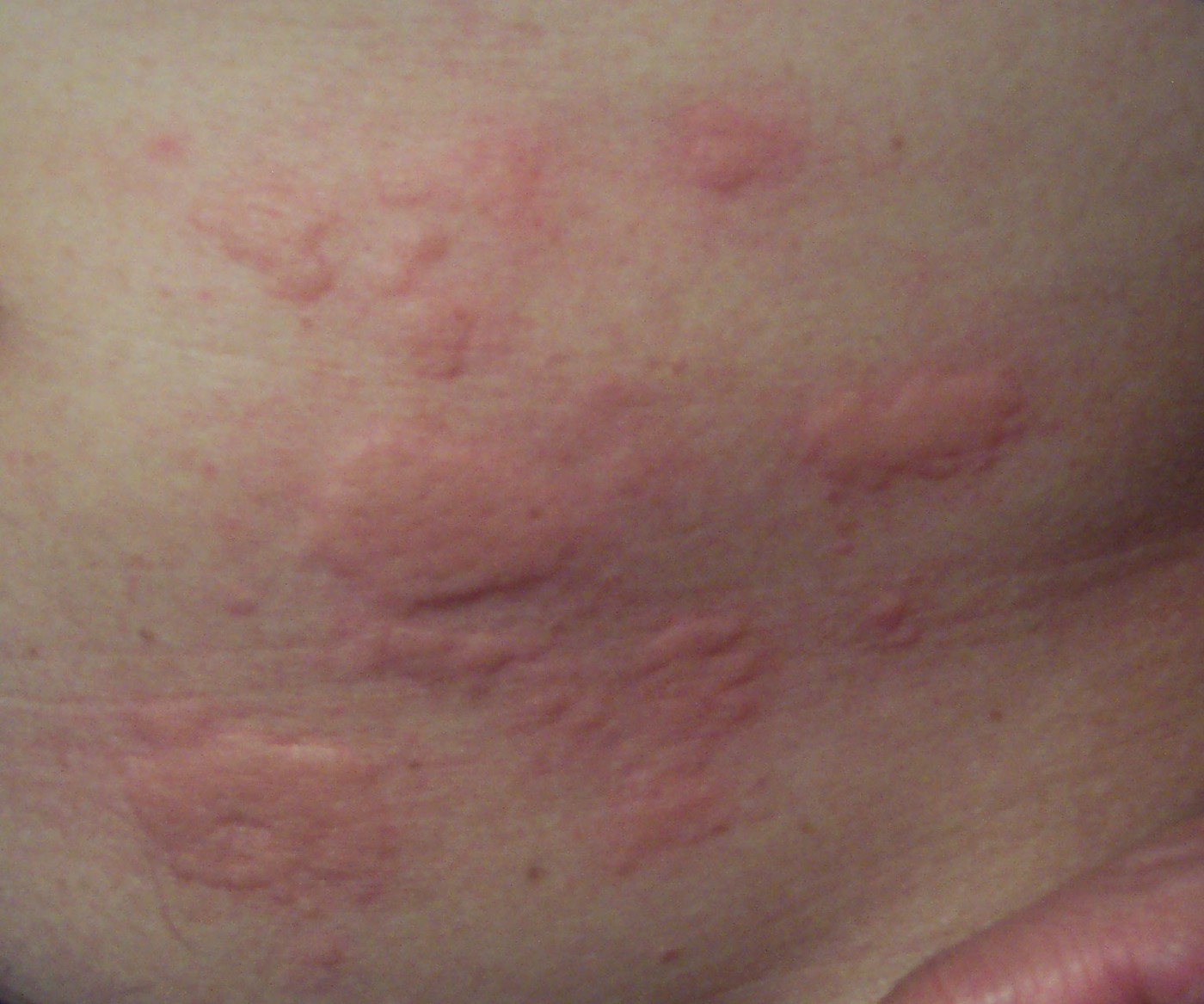
• Wheals: superficial, raised, well-circumscribed erythematous or pink plaques, often with paler centres and a surrounding flare; each individual lesion is transient (<24 hours). |
|
• Angioedema: deeper, non-pitting swelling of soft tissues (lips, eyelids, tongue, extremities); often painful or tingling rather than itchy. |
|
• Dermographism: firmly stroking the skin produces a linear wheal within minutes – the commonest inducible form. |
|
• Airway assessment: where angioedema is present, exclude stridor, hoarseness or respiratory distress. |
|
• Systemic examination: check temperature, joints and lymph nodes if vasculitis or systemic disease is suspected. |
|
⚠️ Common pitfall • Judging the diagnosis by how long the rash lasts rather than how long a single wheal lasts. • A practical test: draw around one wheal with a pen and note the time. • If that individual lesion is still there 24 hours later (especially if painful or bruising), this is not ordinary urticaria. • Think urticarial vasculitis and arrange a biopsy. |
Source: British Association of Dermatologists · DermNet
💬 Patient Explanation
|
Urticaria (hives) happens when cells in your skin release histamine, causing itchy raised welts that come and go, usually fading within a day. |
🧪 Investigations
| Test | Indication |
|---|---|
| No routine tests | Acute or typical chronic spontaneous urticaria needs no investigation – the diagnosis is clinical. |
| FBC, ESR/CRP | Consider in chronic or atypical disease, or where systemic features suggest vasculitis or an underlying disorder. |
| Thyroid function (± thyroid autoantibodies) | Reasonable in chronic spontaneous urticaria, given the recognised association with autoimmune thyroid disease. |
| Specific immunoglobulin E (IgE) or skin-prick testing | • Only where the history points clearly to a specific allergen (e.g. a food, latex or wasp/bee venom) • Not a screening test for spontaneous urticaria |
| Skin biopsy – Specialist-initiated | Where urticarial vasculitis is suspected (wheals >24 hours, painful, bruising). |
Source: British Association of Dermatologists · DermNet
💊 Management
| All patients |
|---|
|
1. Confirm the diagnosis and distinguish acute from chronic. |
|
2. Reassure that it is usually benign, not an allergy, and often self-limiting. |
|
3. Identify and remove any trigger or culprit drug and advise on avoidance. → Advise avoiding non-steroidal anti-inflammatory drugs (NSAIDs) or aspirin and opioids only where they worsen that person's symptoms. |
|
4. Start a regular standard-dose non-sedating antihistamine, taken daily to prevent wheals, not only when they appear. |
|
5. Provide written information and safety-netting for angioedema or airway symptoms. |
| If severe/urgent |
|---|
|
• Severe acute flare → consider a short rescue course of oral prednisolone (not for chronic maintenance). |
|
• Adrenaline auto-injector only where there is a genuine anaphylaxis history (a specialist decision) – not for ordinary urticaria/angioedema. |
|
🔑 Key principle – control with regular antihistamines, reserve steroids for rescue • Urticaria is driven by mast-cell histamine release, usually not by allergy. • The goal is steady suppression of wheals with a regular non-sedating antihistamine, up-dosed as needed and stepped down once settled. • Oral steroids have a role only as a short rescue for severe acute flares. • Steroids do not modify chronic disease and cause harm if used long term. |
Source: British Association of Dermatologists · NICE TA339
🧾 Non-pharmacological Treatment
| Intervention | Details |
|---|---|
| Trigger avoidance | Avoid only where these worsen that person's symptoms: • Non-steroidal anti-inflammatory drugs (NSAIDs) or aspirin • Opioids (e.g. codeine) • Alcohol • Physical triggers (heat, tight clothing, pressure) |
| Symptom relief | • Cool compresses, lukewarm baths and a menthol-containing emollient soothe itch • Discourage scratching |
| Identify inducible triggers | In chronic inducible urticaria, recognising the physical stimulus (cold, pressure, sweating, sunlight) guides advice and self-management. |
| Diet | Routine dietary exclusion is not recommended unless a specific food trigger is clearly identified from the history. |
| Stress and wellbeing | • Address stress where it clearly makes symptoms worse • Offer support for the anxiety, low mood and sleep disruption that chronic urticaria commonly causes |
Source: British Association of Dermatologists · DermNet
⚕️ Pharmacological Treatment
| Treatment Options and Escalation |
|---|
|
➤ Acute urticaria (<6 weeks) |
|
→ Non-sedating (2nd-generation) H1-antihistamine once daily, taken regularly until symptoms settle. Examples: • cetirizine 10 mg (Zirtek/Piriteze) • loratadine 10 mg (Clarityn) • fexofenadine 180 mg (Telfast) • bilastine 20 mg (Ilaxten) |
|
→ Severe/widespread acute flare – a short rescue course of oral prednisolone (e.g. 40 mg once daily for up to 5–7 days). Reserve for severe episodes; do not repeat courses or use for maintenance. |
|
➤ Chronic urticaria (≥6 weeks) – first line |
|
→ Regular standard-dose non-sedating H1-antihistamine taken daily (prophylactically), continued for several weeks; review at 2–4 weeks. |
|
➤ Chronic urticaria – if not controlled |
|
→ Up-titrate the non-sedating antihistamine to up to four times the standard dose (off-label) – e.g. cetirizine up to 10 mg four times daily – before switching agents. |
|
→ Switch to a different non-sedating antihistamine. A sedating antihistamine at night (e.g. chlorphenamine) may help itch-related sleep disturbance. |
|
→ Or add montelukast (Singulair) as an off-label leukotriene-receptor-antagonist adjunct. |
|
➤ Refractory chronic spontaneous urticaria – Specialist-only |
|
→ Omalizumab (Xolair) is an anti-IgE biologic. NICE TA339 recommends it as add-on treatment for severe chronic spontaneous urticaria (CSU) not responding to an H1-antihistamine plus a leukotriene antagonist. • Severity is measured objectively, e.g. urticaria Activity Score over 7 days [UAS7] ≥28. • Dose 300 mg subcutaneously every 4 weeks. • Stopped at or before the 4th dose if there is no response. • Administered by a dermatology, immunology or allergy specialist. |
|
→ Ciclosporin – specialist-initiated immunosuppressant for omalizumab-refractory disease. |
|
⚠️ Common pitfall • Treating chronic urticaria with maintenance steroids. • Repeated oral prednisolone (or topical steroids) is a frequent error. • Steroids give short-term relief but do not alter the natural history of chronic urticaria, and recurrent or long-term courses cause real harm. • When standard-dose antihistamines fail, the evidence-based path is up-dosing (up to 4×), then a leukotriene antagonist, then referral for omalizumab – not steroid dependence. • Topical steroids have no role. |
Source: British Association of Dermatologists · NICE TA339
📌 Special Notes
|
📌 Driving and medication safety • Non-sedating antihistamines are preferred – they cause little impairment at standard dose, though cetirizine can be mildly sedating and effects increase with alcohol or up-dosing. • Sedating antihistamines, such as chlorphenamine (Piriton) and hydroxyzine, impair alertness and driving – it is an offence to drive while impaired by medication; warn patients accordingly. • Hydroxyzine carries an MHRA warning on QT prolongation and torsade de pointes. → Avoid it in people with QT prolongation or significant cardiac disease, in those taking other QT-prolonging drugs, and in the frail elderly. → Use the lowest effective dose for the shortest time. |
• Pregnancy and breastfeeding – if an antihistamine is needed, use the lowest dose of loratadine or cetirizine
→ Chlorphenamine is an alternative with long-standing safety data but is sedating
→ Avoid hydroxyzine in pregnancy
• ACE-inhibitor angioedema – angioedema (often without wheals) can begin months to years after starting an ACE inhibitor.
→ Stop it permanently and avoid all ACE inhibitors.
→ Use angiotensin receptor blockers (ARBs) with caution.
→ Avoid sacubitril/valsartan (Entresto).
• Not an allergy in most chronic cases – chronic spontaneous urticaria is usually autoimmune/idiopathic, so allergy testing and adrenaline auto-injectors are not indicated routinely.
→ Allergy testing only where the history points clearly to a specific allergen.
→ An adrenaline auto-injector only where there is a clear anaphylaxis history.
• Assess impact and control – sleep disruption and quality-of-life impairment matter; a urticaria Activity Score over 7 days (UAS7) or Urticaria Control Test helps quantify severity and the case for escalation or referral.
Source: MHRA · British Association of Dermatologists
➡️ Referral Pathways
| Same-day/Emergency |
|---|
|
• Anaphylaxis or airway angioedema → IM adrenaline and an immediate 999 call for emergency admission or transfer |
|
• Angioedema without wheals + airway symptoms → emergency assessment (suspected ACE-inhibitor-induced or hereditary angioedema) |
| Urgent |
|---|
|
• Suspected urticarial vasculitis (wheals >24h, painful, bruising) → dermatology for biopsy |
|
• Systemic features suggesting vasculitis or autoinflammatory disease → dermatology |
| Routine |
|---|
|
• Chronic urticaria uncontrolled despite up-dosed antihistamine ± leukotriene receptor antagonist (LTRA) → dermatology/immunology (omalizumab assessment) |
|
• Diagnostic uncertainty or significant quality-of-life/psychological impact → dermatology/immunology |
|
• Recurrent angioedema without wheals → immunology for C1-inhibitor testing |
Source: British Association of Dermatologists · DermNet
🏠 Take Home Messages
• Diagnose clinically – itchy wheals that individually resolve within 24 hours and leave no mark are urticaria; acute is <6 weeks, chronic ≥6 weeks, and most chronic disease is spontaneous/autoimmune, not allergic. No routine bloods are needed.
• Antihistamines are the mainstay – a regular standard-dose non-sedating antihistamine first; up-dose to four times standard (off-label) if uncontrolled, then switch or add a leukotriene antagonist, before referral.
• Reserve steroids for rescue – short oral prednisolone courses help severe acute flares only; they do not control chronic urticaria and cause harm long term. Omalizumab (NICE TA339) is the specialist option for refractory chronic spontaneous urticaria (CSU).
• Spot the dangerous mimics – wheals >24h, painful or leaving bruising suggest urticarial vasculitis; angioedema without wheals suggests ACE-inhibitor-induced or hereditary C1-inhibitor disease, where antihistamines and adrenaline are ineffective.
• Always assess the airway – exclude anaphylaxis and laryngeal angioedema in anyone with angioedema or breathing/swallowing difficulty, and treat with IM adrenaline and 999.
Source: British Association of Dermatologists · NICE TA339
|
🧭 AKT – high-yield facts • Individual wheals last <24 hours and resolve without marks. • Acute <6 weeks, chronic ≥6 weeks. • Chronic is usually spontaneous (autoimmune), not allergic. • No investigations for acute/typical urticaria; consider FBC, ESR/CRP and thyroid function only in chronic or atypical disease. • First-line is a regular standard-dose non-sedating antihistamine; up-dose to 4× standard (off-label) before switching or adding montelukast (off-label leukotriene receptor antagonist [LTRA]). • Omalizumab (Xolair, NICE TA339): add-on for severe CSU (e.g. urticaria Activity Score over 7 days [UAS7] ≥28) after H1-antihistamine + LTRA → 300 mg SC every 4 weeks → Stop at/before the 4th dose if no response → Specialist-only • Steroids are for short rescue of severe acute flares only – never chronic maintenance; topical steroids have no role. • Urticarial vasculitis: wheals >24h, painful/burning, leaving bruising/pigmentation → skin biopsy. • Angioedema without wheals → ACE-inhibitor-induced (bradykinin) or hereditary C1-inhibitor deficiency; stop and avoid all ACE inhibitors (and sacubitril). • Hydroxyzine carries an MHRA QT-prolongation warning; in pregnancy use lowest-dose loratadine or cetirizine and avoid hydroxyzine. |
|
🎯 SCA A 34-year-old woman attends with a 3-month history of recurrent itchy hives and occasional lip swelling. Extensive online reading has convinced her it is a food allergy; she requests allergy blood tests and an adrenaline auto-injector, and is frustrated that previous clinicians "found nothing". She has had no breathing difficulty. The challenge is that her health beliefs and expectations conflict with the evidence. Chronic spontaneous urticaria is usually not allergic, immunoglobulin E (IgE) testing is not indicated, and an auto-injector is not warranted without a genuine anaphylaxis history. Yet her symptoms and sleep loss are very real and she feels dismissed. A strong consultation: • Explores her ideas, concerns and expectations (what she fears, what she has read, the impact on sleep, work and mood). • Explains, without dismissing her, why chronic urticaria is usually not a food allergy and why blanket allergy testing and an auto-injector are unlikely to help. • Agrees a shared plan: a regular non-sedating antihistamine taken daily with planned up-dosing and review, targeted testing only if the history points to a specific trigger, and referral if refractory. • Provides clear safety-netting about seeking emergency help for any tongue/throat swelling or breathing difficulty. • Maintains empathy and respects her autonomy throughout. |
📎Reference: NICE CKS. Urticaria. Available from: https://cks.nice.org.uk/topics/urticaria/
📎Reference: Sabroe RA, et al. British Association of Dermatologists guidelines for the management of people with chronic urticaria 2021. Br J Dermatol 2022;186(3):398. Available from: https://academic.oup.com/bjd/article/186/3/398/6705777
📎Reference: NICE. Omalizumab for previously treated chronic spontaneous urticaria (TA339). Available from: https://www.nice.org.uk/guidance/ta339
📎Reference: DermNet. Urticaria (hives): an overview. Available from: https://dermnetnz.org/topics/urticaria-an-overview
📎Reference: British Association of Dermatologists. Urticaria and angioedema (patient information leaflet). Available from: https://www.bad.org.uk/pils/urticaria-and-angioedema
Three whole topics are free to read. Every topic opens with a free account.
Your CPD is counted as you read, and kept from the day you join.
Join us, it’s free