 GPAtlas
🧭 When to screen – the 6 to 8 week baby check
The 6 to 8 week baby check is a scheduled national screening consultation, not a response to a symptom.
• It is the second stage of the Newborn and Infant Physical Examination (NIPE) screening programme – the first being performed within 72 hours of birth.
• In primary care it is usually carried out by the GP at around 8 weeks, alongside the first set of immunisations.
It has two purposes:
• To re-screen the four NIPE conditions – of the eyes, heart, hips and (in boys) testes – because some abnormalities are not detectable at birth and only declare themselves over the following weeks.
• To take a broad view of the baby's health, growth and development, address parental concerns, and deliver high-value health promotion (safe sleep, vitamin D, feeding and immunisations).
A normal newborn examination does not exclude these conditions; the repeat exists precisely because they can appear later. So complete all four screening elements every time, document them, and refer promptly when a screen is positive.
| System | Screening for | Key examination |
|---|---|---|
| Eyes | Congenital cataract, retinoblastoma | Red reflex in both eyes (dim room) |
| Heart | Congenital heart disease, coarctation | Auscultation + femoral pulses |
| Hips | Developmental dysplasia of the hip (DDH) | Barlow & Ortolani, abduction |
| Testes (boys) | Undescended testis (cryptorchidism) | Palpate scrotum – both descended? |
Source: NHS NIPE Screening Programme · NICE NG194
🩺 History
| Ask about wellbeing & development |
|---|
|
• Open with parental concerns about the baby's health, feeding or development? |
|
• How is feeding going (breast or bottle) – latch, volumes, wet and dirty nappies? |
|
• Is the baby giving a responsive social smile yet (emerging around 6 weeks)? |
|
• Do they fix on a face and follow with their eyes, and startle or settle to sound? |
|
• Any concerns about tone, posture or movements, or asymmetry of limb use? |
|
• How are the parents coping, and how is sleep for the family (assess separately from the maternal check)? |
| Ask about background & risk |
|---|
|
• Review the discharge summary and red book – antenatal, birth or perinatal problems, and the result of the Newborn and Infant Physical Examination (NIPE) newborn check? |
|
• Check hip risk factors – breech presentation or a family history of developmental dysplasia of the hip (DDH) – and confirm whether a hip ultrasound was arranged? |
|
• Ask about family history of congenital cataract, retinoblastoma, congenital heart disease or childhood deafness? |
|
• Confirm gestation – preterm babies are screened at the appropriate corrected age – and the newborn hearing screen result? |
|
• Has contact been made with the health visiting team, and are the 8 week immunisations booked? |
|
• Is the baby breastfed or formula-fed, and is vitamin D being given (relevant to supplementation)? |
| 🧩 Parent Perspective |
|---|
|
➤ "Explore any difficulties with feeding or sleep that are affecting the whole family, and how the parents are managing day to day?" |
|
➤ "Ask whether the parents have specific worries – about the baby's eyes, hips or weight gain – and what they are hoping for from today's check?" |
Source: NHS NIPE Screening Programme · NICE NG194
⚠️ Red Flags
| Escalation criteria |
|---|
|
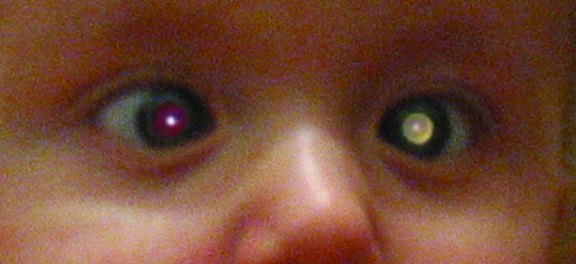
➤ Absent or white red reflex (leukocoria) in one or both eyes → possible congenital cataract or retinoblastoma: • Absent red reflex → urgent paediatric ophthalmology • White reflex (leukocoria) → discuss with ophthalmology the same day |
|
➤ Suspected developmental dysplasia of the hip (DDH) → any one of: • Positive Barlow or Ortolani • Leg-length discrepancy • Limited or asymmetric hip abduction → urgent paediatric orthopaedics |
|
➤ Pathological murmur (loud, harsh, diastolic or pansystolic) or weak or absent femoral pulses → congenital heart disease or coarctation → urgent paediatric cardiology |
|
➤ Bilateral impalpable testes → possible disorder of sex development or virilised female → same-day senior paediatric review |
|
➤ The acutely unwell infant: • Fever • Poor feeding • Lethargy • Reduced tone or responsiveness • Respiratory distress • Non-blanching rash → emergency admission |
|
➤ Head circumference crossing centiles upward (possible hydrocephalus) or suspected craniosynostosis (ridged sutures, abnormal head shape) → urgent paediatrics |
|
➤ Significant faltering growth (a sustained drop across weight centiles) → feeding assessment and paediatric referral if persistent |
Source: NHS NIPE Screening Programme · NICE NG194
🔎 Examination
| The Newborn and Infant Physical Examination (NIPE) infant screening examination |
|---|
|
• General: undress the baby and observe tone, posture, movements, colour and alertness; note any dysmorphic features. |
|
➤ Head & face: • Palpate the fontanelles (soft, not bulging) and sutures (ridging suggests craniosynostosis) • Assess head shape • Inspect and feel the palate for a cleft |
|
➤ Eyes: • Check position, symmetry and scleral colour • Elicit the red reflex in both eyes with an ophthalmoscope in a darkened room • Note any fixed squint |
|
➤ Heart: • Auscultate for rate, rhythm and murmurs • Palpate the femoral pulses for volume and symmetry • Assess colour and perfusion |
|
➤ Hips: • Check leg-length and skin-crease symmetry • Perform Barlow (is the hip dislocatable?) and Ortolani (can a dislocated hip be relocated?) • Assess abduction • Isolated clicks are not significant • Manoeuvres are reliable only up to ~3 months |
|
• Genitalia: in boys, palpate the scrotum to confirm both testes are descended, and check for hypospadias; in either sex, exclude ambiguous genitalia. |
|
• Abdomen: palpate for organomegaly, check the umbilicus, and distinguish a reducible umbilical hernia from an inguinal hernia. |
|
➤ Spine & central nervous system (CNS): • Inspect the spine for a sacral dimple, hairy patch or swelling • Check the clavicles • Assess tone on traction and ventral suspension |
|
• Skin: note birthmarks and rashes; document congenital dermal melanocytosis ("Mongolian blue spots") clearly, to avoid later confusion with bruising. |
|
• Measurements: weigh the baby and measure head circumference, plotting both on the UK-WHO chart in the red book and reviewing the trend. |
|
⚠️ Common pitfall • Rushing the red reflex in a brightly lit room and accepting a dim glow as normal. • The pupil constricts to light, so dim the room and persist, examining each eye in turn. • A white reflex (leukocoria) is never normal – discuss it with ophthalmology the same day. • Congenital cataract should ideally be treated by 8 weeks to protect visual development. |
Source: NHS NIPE Screening Programme · NICE NG194
💬 Patient Explanation
|
This is a routine head-to-toe check that every baby has at this age to make sure they are healthy and developing well. |
🧪 Investigations
| Test | Indication |
|---|---|
| Clinical examination | • The screen itself is a clinical investigation • No routine bloods or imaging are needed when the examination is normal |
| Hip ultrasound – specialist-arranged | • For positive clinical signs (Barlow/Ortolani, limited abduction) or risk factors (breech at or after 36 weeks, first-degree family history of developmental dysplasia of the hip [DDH], an affected multiple) • Usually performed at 4 to 6 weeks |
| Echocardiogram – specialist-arranged | For a pathological murmur or weak or absent femoral pulses, to assess for congenital heart disease or coarctation. |
| Spinal (lumbar) ultrasound – specialist-arranged | For an atypical sacral dimple, meaning any one of: • Deep or > 5 mm • > 2.5 cm from the anus • Off-midline • Base not seen • With other cutaneous markers Or for any associated neurology. |
| Growth charts (UK-WHO) | Plot weight and head circumference and review the trajectory, comparing with the birth measurement. |
| Newborn screen results | Confirm the bloodspot and hearing screens were completed and that any referral from the Newborn and Infant Physical Examination (NIPE) newborn check has been actioned. |
|
🧠 Clinical pearl • Plot the trajectory, not a single point. • One weight in isolation looks reassuring; it is the trend across the centiles that matters. • A sustained fall across two or more weight centile spaces suggests faltering growth. • A rapid upward crossing of head-circumference centiles may be the first sign of hydrocephalus. • Always plot in the red book and compare with previous measurements. |
Source: NHS NIPE Screening Programme · NICE NG194
💊 Management
| All infants |
|---|
|
1. Complete and document all four Newborn and Infant Physical Examination (NIPE) elements (eyes, heart, hips, testes) – normal and abnormal – in the GP record and the red book. |
|
2. Refer promptly on any positive screen. |
|
3. Confirm newborn screening was done and chase any outstanding referral. |
|
4. Plot weight and head circumference and review the trend. |
|
5. Reassure on minor findings – simple umbilical hernia, blocked tear duct, milia, dermal melanocytosis. |
|
6. Deliver health promotion to the parents. |
|
7. Ensure the 8 week immunisations are booked – and never delay them because of any delay to this check. |
| If abnormal findings |
|---|
|
• Faltering growth → feeding assessment, weekly weighing, and paediatric referral if persistent. • Abnormal head growth (head circumference crossing centiles upward, or suspected craniosynostosis) → urgent paediatrics. |
|
🔑 Key principle – a normal newborn screen does not exclude the four NIPE conditions • The whole reason for repeating the examination at 6 to 8 weeks is that the four NIPE conditions can declare themselves after birth. • Coarctation in particular may be silent on the first day and only become apparent as the arterial duct closes in the early weeks. • Screen all four elements every time, document them, and refer promptly on a positive screen. • A reassuring newborn check is never a reason to skip an element. |
Source: NHS NIPE Screening Programme · NICE NG194
🧾 Non-pharmacological Treatment
| Intervention | Details |
|---|---|
| Feeding & nutrition | • Support continued breastfeeding • For bottle-feeding, discuss responsive (paced) feeding. • Vitamin D supplementation is covered under Pharmacological Treatment. |
| Safe sleep (reduce the risk of sudden infant death syndrome [SIDS]) |
Back to sleep for every sleep, in a clear, firm, flat, separate sleep space in the parents' room for the first 6 months. • Room 16–20°C. • No pillows, duvets, pods or nests. • Never sleep with the baby on a sofa or armchair. |
| Smoke-free home | The biggest modifiable SIDS risk – advise a strictly smoke-free environment and offer smoking-cessation support to parents. |
| Attachment & development | • Encourage face-to-face interaction, skin-to-skin contact and responsiveness to cues • Supervised tummy time while awake supports motor development |
| Immunisations | Encourage attendance for the 8 week immunisations (see Pharmacological Treatment) and reassure parents about expected reactions. |
| Support & signposting | • Ensure health visitor contact • Signpost the red book and Start4Life • Remain alert to parental (perinatal) mental health |
Source: NICE NG194 · The Lullaby Trust · UKHSA
⚕️ Pharmacological Treatment
| Treatment Options and Escalation |
|---|
|
➤ The screening check itself needs no drug treatment |
|
→ The value of the consultation lies in screening, referral and health promotion. The two routine prescribing points are vitamin D and prophylactic paracetamol around the meningococcal group B (MenB) vaccination. |
|
➤ Vitamin D supplementation |
|
→ Colecalciferol (vitamin D3) 8.5–10 micrograms (340–400 international units [IU]) once daily for all breastfed babies from birth to 1 year, and for formula-fed babies taking < 500 mL/day. • Babies on ≥ 500 mL/day of infant formula do not need it (formula is fortified). |
|
→ Eligible families can get free Healthy Start children's vitamin drops (vitamins A, C and D); over-the-counter multivitamin drops (e.g. Abidec, Dalivit) are alternatives. • Warning: do not exceed the dose – the upper limit under 1 year is 25 micrograms/day (excess risks hypercalcaemia). |
|
➤ Prophylactic paracetamol after MenB vaccination (given at 8 and 12 weeks) |
|
→ More than half of infants develop fever when MenB is given with the other vaccines, so give three doses of infant paracetamol 120 mg/5 mL (e.g. Calpol Infant) – 2.5 mL (60 mg) per dose: • The first at or soon after vaccination. • The second 4–6 hours later. • The third 4–6 hours after that. |
|
→ Warning: use the infant strength (120 mg/5 mL), not the "6 years plus" product. • Do not exceed 4 doses in 24 hours. • Very preterm babies (< 32 weeks) are dosed by weight. • Prophylaxis is not needed for the 12-month MenB booster. |
|
➤ Conditions found incidentally at the check – treat by topic, not as screening |
|
→ Oral thrush: first-line nystatin oral suspension in this age group – miconazole oral gel is contraindicated under 4 months (choking risk). • Reflux (GORD): positioning and feeding advice first, then an alginate (Gaviscon Infant) if needed. • Eczema: liberal emollients ± a mild topical corticosteroid. |
Source: UKHSA · NICE NG194
📌 Special Notes
|
📌 Safety-netting – the unwell young infant • Advise parents to seek urgent help if the baby has a fever of 38°C or higher (under 3 months), is feeding poorly, is floppy, drowsy or unrousable, has fast or laboured breathing, or develops a non-blanching rash. • A high-pitched or inconsolable cry, a bulging fontanelle, or a baby who is simply "not themselves" should prompt same-day assessment – serious illness can progress quickly at this age. |
• The check and the vaccines are separate – the 6 to 8 week examination is not required before immunising, so the 8 week vaccines must never be delayed by a delay to the check (this would leave the baby unprotected against whooping cough).
• A normal Newborn and Infant Physical Examination (NIPE) newborn check does not exclude the four NIPE conditions – confirm the newborn screen was done and chase any outstanding referral.
• Beyond ~3 months, rely on abduction, leg-length symmetry and, once walking, gait – not Barlow and Ortolani.
• The maternal 6 to 8 week postnatal check is a separate consultation – use the contact to ask how parents are coping and to remain alert to perinatal mental illness.
• Preterm babies are screened at the appropriate corrected age, and safe-sleep advice is followed for a year from the due date.
Source: NHS NIPE Screening Programme · The Lullaby Trust
➡️ Referral Pathways
| Same-day/Emergency |
|---|
|
• Acutely unwell infant (fever under 3 months, poor feeding, reduced responsiveness, respiratory distress, non-blanching rash) → emergency admission |
|
• Bilateral impalpable testes → same-day senior paediatric review |
|
• White reflex (leukocoria) raising concern for retinoblastoma → discuss with ophthalmology the same day |
| Urgent (specialist) |
|---|
|
• Absent red reflex → urgent paediatric ophthalmology (seen within 2 weeks) |
|
• Positive Barlow/Ortolani or limited abduction → urgent paediatric orthopaedics or hip clinic |
|
• Pathological murmur or weak/absent femorals → urgent paediatric cardiology |
|
• Abnormal head growth or craniosynostosis → urgent paediatrics |
| Routine |
|---|
|
• Unilateral undescended testis → paediatric surgery or urology (orchidopexy by ~6–12 months) |
|
• Atypical sacral dimple → spinal ultrasound referral |
|
• Health visitor → feeding, growth and parenting support • Faltering growth → feeding assessment, weekly weighing, and paediatric referral if persistent |
|
• Persistent watering eye (blocked tear duct beyond ~12 months) → routine ophthalmology |
Source: NHS NIPE Screening Programme · NICE NG194
🏠 Take Home Messages
• Screen all four Newborn and Infant Physical Examination (NIPE) pillars every time – eyes (red reflex → cataract/retinoblastoma), heart (murmur + femoral pulses → congenital heart disease or coarctation), hips (Barlow/Ortolani → Developmental dysplasia of the hip [DDH]) and testes (undescended). The repeat exists because these can declare after the newborn check.
• The red reflex and the femoral pulses are the most-missed elements – dim the room for the eyes and palpate both femorals every time; a white reflex or absent femoral pulse is never normal.
• Hips: Barlow tests if the hip is dislocatable, Ortolani if a dislocated hip relocates; refer any positive sign or limited abduction urgently – the manoeuvres are reliable only to ~3 months.
• Plot weight and head circumference and read the trajectory, not a single point – a sustained centile drop suggests faltering growth, a rapid upward head-circumference crossing suggests hydrocephalus.
• Seize the health-promotion opportunity – safe sleep, vitamin D for breastfed babies, and the 8 week immunisations, which must never be delayed by the check.
Source: NHS NIPE Screening Programme · NICE NG194 · UKHSA
|
🧭 AKT – high-yield facts • The four NIPE conditions – eyes (congenital cataract, retinoblastoma), heart (congenital heart disease incl. coarctation), hips (DDH) and testes (undescended) – are screened within 72 hours and again at 6 to 8 weeks. • Barlow attempts to dislocate the hip; Ortolani relocates a dislocated hip. Both are reliable only up to ~3 months. • Hip ultrasound for risk factors: breech at or after 36 weeks, first-degree family history of DDH, or an affected multiple – performed at 4 to 6 weeks. • Check the red reflex in a dim room. For an absent or white reflex: absent → urgent ophthalmology, white → discuss with ophthalmology the same day. Congenital cataract is ideally treated by 8 weeks. • Coarctation can be silent at the newborn check and declare as the duct closes – weak or absent femoral pulses are the cardinal sign. • 8 week immunisations: 6-in-1, MenB (Bexsero) and oral rotavirus. Give 3 doses of infant paracetamol (2.5 mL = 60 mg) after MenB – and never delay vaccines for the baby check. • Vitamin D 8.5–10 micrograms (340–400 international units [IU]) daily for breastfed babies; not needed if taking ≥ 500 mL/day of formula. |
|
🎯 SCA A first-time mother brings her 7-week-old daughter for the baby check. The baby was born on the 25th centile but now plots on the 2nd. Feeding has been difficult and the mother becomes tearful, saying she feels like a failure and that she is "not bonding". The challenge is to address a genuine screening and growth concern and an emerging maternal mental-health issue together, sensitively, within a short consultation – without the mother feeling blamed, and while keeping the baby safe. A strong consultation: • Explores her ideas, concerns and expectations (her worries about feeding and "failing"). • Gently asks about mood, coping and support. • Examines and plots the growth, explaining faltering growth and an agreed feeding plan with weekly weighing. • Makes a shared plan involving the health visitor, feeding support and GP follow-up, and considers perinatal mental-health input. • Safety-nets for both the unwell baby and for the mother. • Shows empathy throughout, without judgement. |
📎Reference: NHS England. Newborn and infant physical examination (NIPE) screening programme handbook. Available from: https://www.gov.uk/government/publications/newborn-and-infant-physical-examination-programme-handbook
📎Reference: NICE NG194. Postnatal care. Available from: https://www.nice.org.uk/guidance/ng194
📎Reference: UKHSA. The complete routine immunisation schedule. Available from: https://www.gov.uk/government/publications/the-complete-routine-immunisation-schedule
📎Reference: UKHSA. Using paracetamol to prevent and treat fever after MenB vaccination. Available from: https://www.gov.uk/government/publications/menb-vaccine-and-paracetamol/using-paracetamol-to-prevent-and-treat-fever-after-menb-vaccination
📎Reference: The Lullaby Trust. Safer sleep for babies. Available from: https://www.lullabytrust.org.uk/baby-safety/safer-sleep-information/safer-sleep-overview/
📎Reference: NHS. Vitamins for babies (Best Start in Life). Available from: https://www.nhs.uk/best-start-in-life/baby/baby-basics/caring-for-your-baby/vitamins-for-babies/
Three whole topics are free to read. Every topic opens with a free account.
Your CPD is counted as you read, and kept from the day you join.
Join us, it’s free