 GPAtlas
🧭 When to suspect
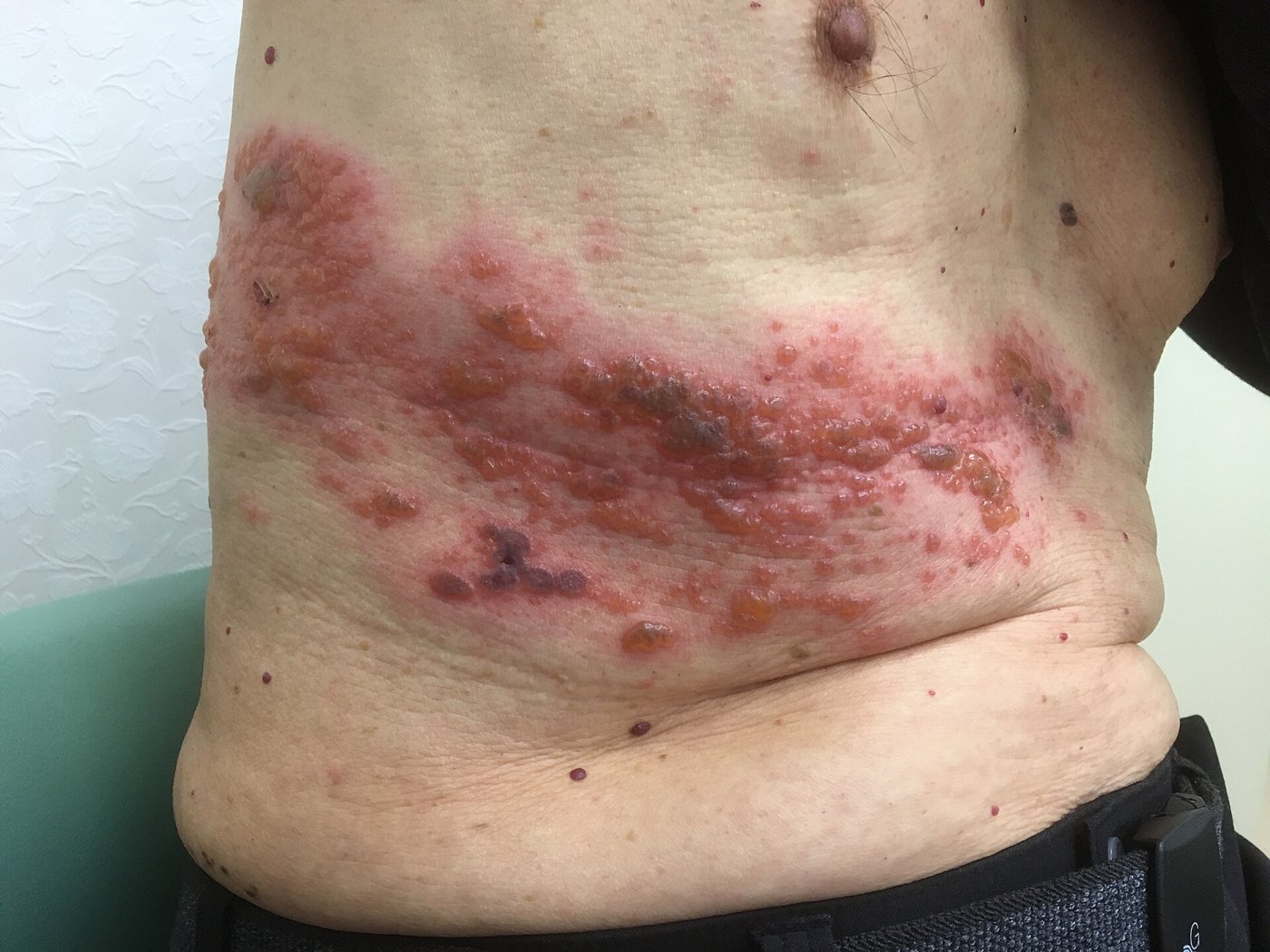
Shingles (herpes zoster) is reactivation of latent varicella zoster virus (VZV) lying dormant in a sensory ganglion since primary chickenpox. It produces a painful, unilateral, vesicular rash confined to a single dermatome that characteristically stops at the midline.
Suspect it whenever an older or immunocompromised patient describes burning, tingling or itching in a band of skin – with or without a rash yet visible.
• A prodrome of dermatomal pain, paraesthesia or itch typically precedes the rash by 1–5 days, sometimes with malaise, headache or low-grade fever.
• Occasionally pain occurs with no rash at all (zoster sine herpete).
• The thoracic dermatomes are most often affected, followed by the ophthalmic division of the trigeminal nerve.
• Risk rises sharply with age over 50 and with any cause of impaired cell-mediated immunity.
In primary care:
• Recognise the dermatomal pattern
• Decide promptly who needs an antiviral within 72 hours
• Never miss the sight- or function-threatening forms (ophthalmic zoster and Ramsay Hunt syndrome)
• Offer the Shingrix vaccine to those eligible to prevent it
| Phase | Typical features | Timing |
|---|---|---|
| Prodrome | • Burning, tingling, itch or pain in one dermatome • Sometimes malaise, headache, fever |
1–5 days before rash |
| Eruptive | • Erythematous macules/papules → grouped vesicles on a red base → pustules • Unilateral, single dermatome, respects midline |
Days 0–7 |
| Crusting | • Vesicles dry and crust over • Patient remains infectious until fully crusted |
7–10 days (heals over 2–4 weeks) |
| Post-herpetic neuralgia | Neuropathic pain persisting at the site after the rash has healed | Pain > 90 days from onset |
Source: NICE · UK Health Security Agency
🩺 History
| Ask about symptoms |
|---|
|
• Establish a unilateral, painful, vesicular rash, and confirm it is confined to one side and does not cross the midline? |
|
• Ask about a prodrome of pain, tingling, burning or itch in the area before the rash appeared? |
|
• Pin down onset time – how many hours or days since the rash started (decisive for the < 72-hour antiviral window)? |
|
• Ask about eye pain, redness, watering or any change in vision (ophthalmic involvement)? |
|
• Ask about ear pain, facial weakness or vesicles in/around the ear (Ramsay Hunt)? |
|
• Ask about systemic features (fever, headache, malaise) and the severity of pain and its effect on sleep? |
| Ask about risk factors and modifiers |
|---|
|
• Confirm previous chickenpox – the prerequisite for reactivation? |
|
• Identify immunocompromise – HIV, haematological malignancy, chemotherapy, high-dose or long-term corticosteroids, methotrexate or other immunosuppressants, transplant? |
|
• Establish age – both risk and post-herpetic neuralgia rise over 50? |
|
• Ask about recent significant physical or psychological stress? |
|
• Check pregnancy or breastfeeding status (affects antiviral choice and counselling)? |
|
• Ask about shingles vaccination status and eligibility? |
| 🧩 Patient Perspective |
|---|
|
➤ "Explore the patient's understanding of shingles, and their worries about passing chickenpox to vulnerable contacts – pregnant women, newborns, the immunocompromised?" |
|
➤ "Ask how the pain is affecting sleep, mood and daily activities, and what they are most concerned about?" |
Source: NICE
⚠️ Red Flags
| Escalation criteria |
|---|
|
➤ Herpes zoster ophthalmicus → any one of: • Vesicles on the tip or side of the nose (Hutchinson's sign) • Red eye • Any visual change → same-day ophthalmology |
|
➤ Facial weakness with ear pain and vesicles in the ear canal, pinna or palate → Ramsay Hunt syndrome → urgent ENT or specialist + antiviral now |
|
➤ Rash → any one of: • Affecting more than two dermatomes • Bilateral • Crossing the midline → disseminated zoster → suspect significant immunocompromise |
|
➤ Immunocompromised patient with shingles → risk of severe or disseminated disease → treat without delay, low threshold for admission |
|
➤ Possible meningitis or encephalitis → any one of: • Headache • Neck stiffness • Confusion • Drowsiness • Focal neurology → emergency admission |
|
➤ Secondary bacterial infection → any one of: • Spreading erythema • Increasing pain • Purulent discharge • Systemic sepsis → suspected sepsis in a person aged 16 or over who meets any NICE high-risk criteria → emergency medical care (usually 999 ambulance) |
|
➤ Severe pain not controlled by initial analgesia → escalate analgesia and review |
Source: NICE · UK Health Security Agency
🔎 Examination
| Examination findings and signs |
|---|
|
• Distribution – confirm a unilateral rash following a single dermatome (thoracic most common, then ophthalmic/cervical) that respects the midline. |
|
• Lesion stage – macules and papules evolving to grouped vesicles on a red base, then pustules and crusts; note whether new vesicles are still forming (this guides later antiviral use). |
|
• Eye – look for Hutchinson's sign (nasociliary vesicles on the nose), conjunctival injection and any visual change; check visual acuity. |
|
• Cranial nerves and ear – assess facial (VII) nerve function and inspect the external auditory meatus and palate for vesicles (Ramsay Hunt). |
|
• Motor – check for segmental motor weakness in the affected myotome (zoster paresis). |
|
• Systemic – temperature and signs of spreading bacterial infection or sepsis. |
Source: NICE
💬 Patient Explanation
|
Shingles is a painful, blistering rash caused by the chickenpox virus reawakening in a nerve, years after you first had chickenpox. |
🧪 Investigations
| Test | Indication |
|---|---|
| Clinical diagnosis | Almost always made on the typical history and the unilateral dermatomal rash – no test is needed in a clear-cut case. |
| Viral polymerase chain reaction (PCR) – vesicle fluid swab | • Reserve for diagnostic uncertainty (e.g. distinguishing varicella zoster virus [VZV] from herpes simplex), atypical presentations, or immunocompromised patients • Swab fresh vesicle fluid |
| HIV test | Offer to anyone with shingles that is recurrent, multidermatomal, unusually severe, or occurring in a younger adult – herpes zoster is an HIV indicator condition. |
| Other bloods | • Not routinely required • Consider if systemically unwell, immunocompromised, or admission is likely – usually arranged in secondary care |
💊 Management
| All patients |
|---|
|
1. Confirm the diagnosis clinically and decide whether an antiviral is indicated. |
|
2. Start analgesia early and treat pain proactively; advise simple rash care. |
|
3. Give infection-control advice until lesions have crusted. |
|
4. Provide safety-netting for post-herpetic neuralgia, secondary bacterial infection, and eye or neurological symptoms. |
|
5. Offer Shingrix vaccination at recovery if eligible (prevention, not treatment). |
| If severe/urgent |
|---|
|
• Ophthalmic, disseminated or neurological red flag → same-day specialist referral or admission. • Ramsay Hunt syndrome → urgent ENT or neurology referral + antiviral now. |
|
• Severe acute pain → step up to a neuropathic agent early alongside simple analgesia. |
|
• Oral corticosteroids are not routinely recommended – only on specialist advice in selected immunocompetent patients with severe pain. |
|
🔑 Key principle – treat early, treat the pain, prevent the next one • Three priorities run together in shingles. • Start an antiviral within 72 hours for those who will benefit. • Manage pain aggressively from the outset (acute pain severity predicts post-herpetic neuralgia). • Offer the non-live Shingrix vaccine to eligible patients once recovered. • Antivirals shorten the illness and reduce complications but do not reliably prevent post-herpetic neuralgia – so pain control is never an afterthought. |
Source: NICE · UK Health Security Agency
🧾 Non-pharmacological Treatment
| Intervention | Details |
|---|---|
| Rash care | • Keep the area clean and dry • Cover weeping lesions with a non-adherent dressing or loose clothing to reduce bacterial infection and onward transmission |
| Symptom relief | • Loose-fitting cotton clothing • Cool compresses or calamine may ease itch • Avoid topical antibiotics or creams unless there is secondary infection |
| Infection control | • Infectious via contact with vesicle fluid until lesions crust • Advise avoiding non-immune pregnant women, newborns and the immunocompromised until then, and keep the rash covered |
| Self-care and review | • Reassure about the typical 2–4 week course • Advise on analgesia and hydration, and when to seek review (eye symptoms, spreading infection, uncontrolled pain) |
| Prevention | Recommend Shingrix to those eligible to reduce the risk of future episodes and post-herpetic neuralgia (see Pharmacological). |
|
⚠️ Common pitfall • Telling a patient they will "give someone shingles". • You cannot catch shingles from another person. • Contact with shingles vesicle fluid can cause chickenpox in someone who has never had it or been vaccinated – not shingles. • The practical message: cover the rash and stay away from non-immune pregnant women, newborns and the immunocompromised until it crusts. • Ordinary contacts who have had chickenpox are not at risk. |
Source: NICE · UK Health Security Agency
⚕️ Pharmacological Treatment
| Treatment Options and Escalation |
|---|
|
→ Offer an oral antiviral, ideally within 72 hours of rash onset, to: • all immunocompromised patients (any timeframe) • immunocompetent patients with any of: age over 50, non-truncal involvement (face, eye, limb, perineum), moderate-to-severe pain, or moderate-to-severe rash. |
|
→ Consider an antiviral after 72 hours → any one of: • New vesicles still forming • Ophthalmic or neurological involvement • Immunocompromise • Severe disease or a significant risk of complications |
|
→ Aciclovir 800 mg five times daily for 7 days (dispersible tablets and liquid available). |
|
→ Valaciclovir (Valtrex) 1 g three times daily for 7 days – preferred for simpler dosing and adherence. |
|
→ Famciclovir (Famvir) 500 mg three times daily for 7 days. |
|
→ Reduce the dose in renal impairment for all three and ensure good hydration. → Immunocompromised patients need longer courses (famciclovir 10 days, or continue aciclovir until 48 hours after crusting) and may need IV aciclovir. |
|
→ Paracetamol ± codeine, with or without an NSAID (caution in the frail elderly, renal impairment and gastrointestinal [GI] risk). |
|
→ If pain is more neuropathic or severe, add amitriptyline 10 mg at night (5 mg if frail/elderly), titrated as tolerated, or a gabapentinoid. |
|
➤ Post-herpetic neuralgia (pain persisting beyond ~90 days) |
|
→ Offer one of amitriptyline, duloxetine, gabapentin or pregabalin first-line; switch to another if ineffective or not tolerated. |
|
→ Capsaicin 0.075% cream (Axsain) for localised pain in those avoiding or unable to tolerate oral drugs; lidocaine 5% medicated plasters (Versatis) are a specialist/formulary option for localised pain. |
|
→ Use tramadol only as short-term rescue; do not initiate long-term opioids for neuropathic pain in primary care. |
|
➤ Drug-safety cautions (MHRA) |
|
→ Gabapentin and pregabalin are Schedule 3 controlled drugs (Class C) – risk of misuse, dependence and respiratory depression (greatest with opioids, in the elderly, in respiratory disease or renal impairment); start low, review, and plan a stop date. |
|
→ Pregabalin in pregnancy may slightly increase the risk of major congenital malformations – advise effective contraception and avoid unless clearly necessary. |
|
→ Amitriptyline – anticholinergic effects and falls risk in older adults, caution in cardiovascular disease, and dangerous in overdose. → All three neuropathic agents impair driving (see Special Notes). |
|
➤ Prevention – Shingrix (recombinant, non-live) |
|
→ 2 doses. → Being non-live, it is safe in immunocompromised patients (it replaced live Zostavax). → It is not a treatment for acute shingles. |
|
→ All severely immunosuppressed adults aged 18 and over (2nd dose 8 weeks to 6 months after the 1st). |
|
→ Immunocompetent adults: routine at 65 and 70 (2nd dose 6–12 months apart). → Those aged 70–79 are eligible up to their 80th birthday. → The programme is a phased extension towards routine vaccination from 60 over a 10-year rollout. |
|
🧠 Clinical pearl • The 72-hour rule is a guide, not a wall. • Always treat immunocompromised patients whenever they present. • Still consider an antiviral after 72 hours if new vesicles are appearing, there is ophthalmic or neurological involvement, the patient is immunocompromised, or the disease is severe or carries a significant risk of complications. • Where there is a choice, valaciclovir or famciclovir are preferred over aciclovir. Three-times-daily dosing aids adherence, and both modestly outperform aciclovir for zoster-associated pain. |
Source: NICE · MHRA · UK Health Security Agency
📌 Special Notes & Driving
|
📌 Safety – driving and sedating medicines • Shingles itself carries no DVLA notification duty – there are no shingles-specific licence rules. • However, patients should not drive while feeling unwell, or if ophthalmic involvement affects their vision. • Amitriptyline, gabapentin and pregabalin commonly cause drowsiness and can impair driving – warn patients not to drive if affected; it is an offence to drive while impaired by medication. |
• Pregnancy and breastfeeding – seek specialist advice. Where treatment is indicated, aciclovir has the most safety data and is generally first-line. A non-immune pregnant contact exposed to vesicle fluid risks chickenpox, not shingles – manage as a varicella zoster virus (VZV) exposure.
• HIV testing – offer to anyone with recurrent, multidermatomal, severe or younger-onset shingles, as herpes zoster is an HIV indicator condition.
• Shingrix is non-live – the key reason it replaced Zostavax and can be given safely to immunocompromised patients.
• Previous Zostavax recipients who are now eligible (e.g. having become immunosuppressed) should still receive 2 doses of Shingrix.
• No topical antivirals – topical aciclovir has no role in cutaneous shingles; use oral therapy.
Source: NICE · DVLA · UK Health Security Agency
➡️ Referral Pathways
| Same-day/Emergency |
|---|
|
• Disseminated zoster or neurological features (meningism, encephalitis) → emergency admission |
|
• Immunocompromised with severe/disseminated disease or unable to take/tolerate oral antivirals → admission for IV aciclovir |
|
• Ophthalmic zoster (Hutchinson's sign, red eye, visual change) → same-day ophthalmology |
| Urgent specialist |
|---|
|
• Ramsay Hunt syndrome (facial palsy + ear vesicles) → urgent ENT/neurology + antiviral |
|
• Pregnancy with shingles needing treatment → specialist advice |
| Routine |
|---|
|
• Persistent or severe post-herpetic neuralgia (PHN) unresponsive to first-line agents → pain clinic |
|
• Recurrent or atypical shingles → dermatology ± HIV/immunology assessment |
|
• Diagnostic uncertainty → dermatology |
Source: NICE
🏠 Take Home Messages
• Diagnose clinically – a unilateral, dermatomal vesicular rash that respects the midline, often preceded by a prodrome of pain, tingling or itch.
• Treat the right people within 72 hours – all immunocompromised patients (anytime), and immunocompetent patients aged over 50 or with non-truncal/ophthalmic involvement, moderate-severe pain or rash, using aciclovir, valaciclovir or famciclovir.
• Never miss the dangerous forms – Hutchinson's sign means same-day ophthalmology, and facial palsy with ear vesicles means Ramsay Hunt; both threaten function and need urgent referral.
• Treat pain hard and early – acute pain predicts post-herpetic neuralgia (PHN); offer amitriptyline, duloxetine, gabapentin or pregabalin for PHN, mindful of gabapentinoid dependence and the MHRA pregabalin pregnancy warning.
• Prevent the next episode – offer non-live Shingrix to severely immunosuppressed adults from 18, and to immunocompetent adults at 65 and 70–79.
Source: NICE · UK Health Security Agency
|
🧭 AKT – high-yield facts • Antiviral regimens: aciclovir 800 mg five times daily, valaciclovir 1 g three times daily, or famciclovir 500 mg three times daily, each for 7 days; reduce dose in renal impairment. • Treat within 72 hours if immunocompromised (any time), or immunocompetent and aged over 50, non-truncal, or moderate-severe pain/rash. • Hutchinson's sign (vesicles on the tip or side of the nose) = nasociliary nerve involvement = high risk of ocular disease → same-day ophthalmology. • Ramsay Hunt = facial palsy + ear vesicles (geniculate ganglion). • PHN first-line = amitriptyline, duloxetine, gabapentin or pregabalin (NICE choice of one). • Shingrix is non-live (recombinant): → Severely immunosuppressed adults aged 18 and over → Immunocompetent adults aged 65 and 70 (catch-up for those aged 70–79) → 2 doses • You cannot catch shingles – contact with vesicle fluid causes chickenpox in the non-immune. |
|
🎯 SCA A 34-year-old attends with a painful dermatomal rash you recognise as shingles – his second episode in two years, and he is otherwise fit. Recurrent and younger-onset shingles is an HIV indicator condition, so an HIV test is indicated. The challenge is to raise this in a normalised, non-judgemental way alongside treating today's episode, without causing alarm or implying assumptions about his lifestyle. A strong consultation: • Explores his ideas, concerns and expectations about the rash and its recurrence. • Explains in plain terms why recurrent shingles prompts a routine check of immunity, and normalises HIV testing as something offered to anyone with recurrent shingles. • Obtains informed consent for the test while respecting his autonomy to decline. • Agrees a shared plan covering antiviral treatment, analgesia and the blood test. • Clearly safety-nets about eye or neurological symptoms, secondary infection and how results will be given. • Maintains empathy and confidentiality throughout. |
📎Reference: NICE CKS. Shingles. Available from: https://cks.nice.org.uk/topics/shingles/
📎Reference: UK Health Security Agency. Shingles immunisation programme: information for healthcare practitioners. Available from: https://www.gov.uk/government/publications/shingles-vaccination-guidance-for-healthcare-professionals/shingles-immunisation-programme-information-for-healthcare-practitioners
📎Reference: NICE CG173. Neuropathic pain in adults: pharmacological management in non-specialist settings. Available from: https://www.nice.org.uk/guidance/cg173
📎Reference: MHRA. Drug Safety Update – Pregabalin (Lyrica): findings of safety study on risks during pregnancy. Available from: https://www.gov.uk/drug-safety-update/pregabalin-lyrica-findings-of-safety-study-on-risks-during-pregnancy
📎Reference: NHS. Shingles. Available from: https://www.nhs.uk/conditions/shingles/
Three whole topics are free to read. Every topic opens with a free account.
Your CPD is counted as you read, and kept from the day you join.
Join us, it’s free