 GPAtlas
🧭 When to suspect
Rheumatoid arthritis (RA) is a chronic, systemic autoimmune disease:
• Affecting around 1% of the UK population
• Roughly three times more common in women
• Peak onset between 40 and 60 years (though it can present at any age)
• Smoking is the strongest modifiable risk factor
Suspect RA in any adult with persistent synovitis – soft-tissue swelling, warmth and tenderness of a joint – that does not settle within a few weeks.
The classic pattern:
• A symmetrical polyarthritis of the small joints of the hands (metacarpophalangeal [MCP] and proximal interphalangeal [PIP]) and feet (metatarsophalangeal [MTP])
• Early-morning stiffness lasting more than 30 minutes (often considerably longer)
• Prominent systemic fatigue
Early recognition and rapid referral matter most:
• There is a narrow “window of opportunity” in which disease-modifying therapy can prevent irreversible joint destruction.
• Referral is made on clinical grounds and must never be delayed while awaiting blood tests or X-rays – these are frequently normal in early disease.
| Feature | Inflammatory (RA) | Degenerative (osteoarthritis) |
|---|---|---|
| Early-morning stiffness | Prolonged, > 30 min (often > 1 hour) | • Brief, < 30 min • Stiffness after rest |
| Pattern | Symmetrical, polyarticular | Often asymmetrical |
| Joints typically involved | MCP, PIP, wrists, MTP (spares DIPs) | DIPs, first carpometacarpal, knees, hips |
| Effect of activity | Eases with movement | Worsens with use, eases with rest |
| Systemic features | Fatigue, malaise common | Absent |
|
🧠 Clinical pearl • In RA the distal interphalangeal (DIP) joints are characteristically spared. • Prominent DIP involvement should instead prompt thoughts of osteoarthritis or psoriatic arthritis (look for nail pitting, dactylitis and a personal or family history of psoriasis). • Asymmetry, a single hot joint, or a rapid severe attack suggests another diagnosis – gout, pseudogout or septic arthritis. |
Source: NICE NG100 · NICE QS33
🩺 History
| Ask about symptoms |
|---|
|
• Establish which joints are affected and whether the distribution is symmetrical (both sides of the body)? |
|
• Quantify early-morning stiffness – does it last more than 30 minutes, and recur after rest? |
|
• Was the onset gradual (typical of rheumatoid arthritis [RA]) or sudden? |
|
• Identify systemic features – fatigue, malaise, low-grade fever, night sweats or weight loss? |
|
• Assess functional impact – grip, opening jars, buttons, walking? |
|
➤ Screen for extra-articular symptoms: • Dry, red or painful eyes • Breathlessness or cough • Skin nodules or rash |
| Ask about risk factors and modifiers |
|---|
|
• Check smoking status – current or former – the strongest modifiable risk factor for RA? |
|
• Ask about a family history of RA or other autoimmune disease? |
|
• Review cardiovascular risk factors – RA is an independent risk factor for cardiovascular disease (CVD)? |
|
• Ask about other autoimmune conditions and relevant comorbidity? |
|
• Take a medication history and note any prior joint problems? |
|
• In women, ask about pregnancy or plans to conceive (relevant to future drug choice)? |
| 🧩 Patient Perspective |
|---|
|
➤ "Explore how the symptoms are affecting daily life – work, self-care, hobbies and sleep – and what the patient is most worried about?" |
|
➤ "Ask about the impact of pain, stiffness and fatigue on mood, relationships and independence?" |
Source: NICE NG100
⚠️ Red Flags
| Escalation criteria |
|---|
|
➤ Hot, red, swollen joint the patient cannot move → suspected septic arthritis → same-day admission for urgent combined medical and surgical assessment |
|
➤ Fever with a single acutely inflamed joint, or an inflamed prosthetic joint → septic arthritis until proven otherwise |
|
➤ Possible cervical myelopathy or atlanto-axial subluxation → any one of: • Neck pain • Paraesthesia • Limb weakness • Unsteadiness • New sphincter disturbance → neck pain alone: urgent assessment → paraesthesia, limb weakness, unsteadiness or new sphincter disturbance: same-day urgent specialist input |
|
➤ Severe eye pain with redness → possible scleritis → same-day ophthalmology |
|
➤ New or worsening breathlessness or dry cough → possible interstitial lung disease (ILD) → new persistent dry cough or gradually progressive breathlessness: urgent assessment for ILD → acute or rapidly worsening breathlessness, hypoxia or significant respiratory compromise: same-day urgent specialist input |
|
➤ Possible rheumatoid vasculitis → any one of: • Purpuric or vasculitic rash • Mononeuritis multiplex • Florid systemic upset → same-day urgent rheumatology review |
Source: NICE NG100
🔎 Examination
| Examination findings and signs |
|---|
|
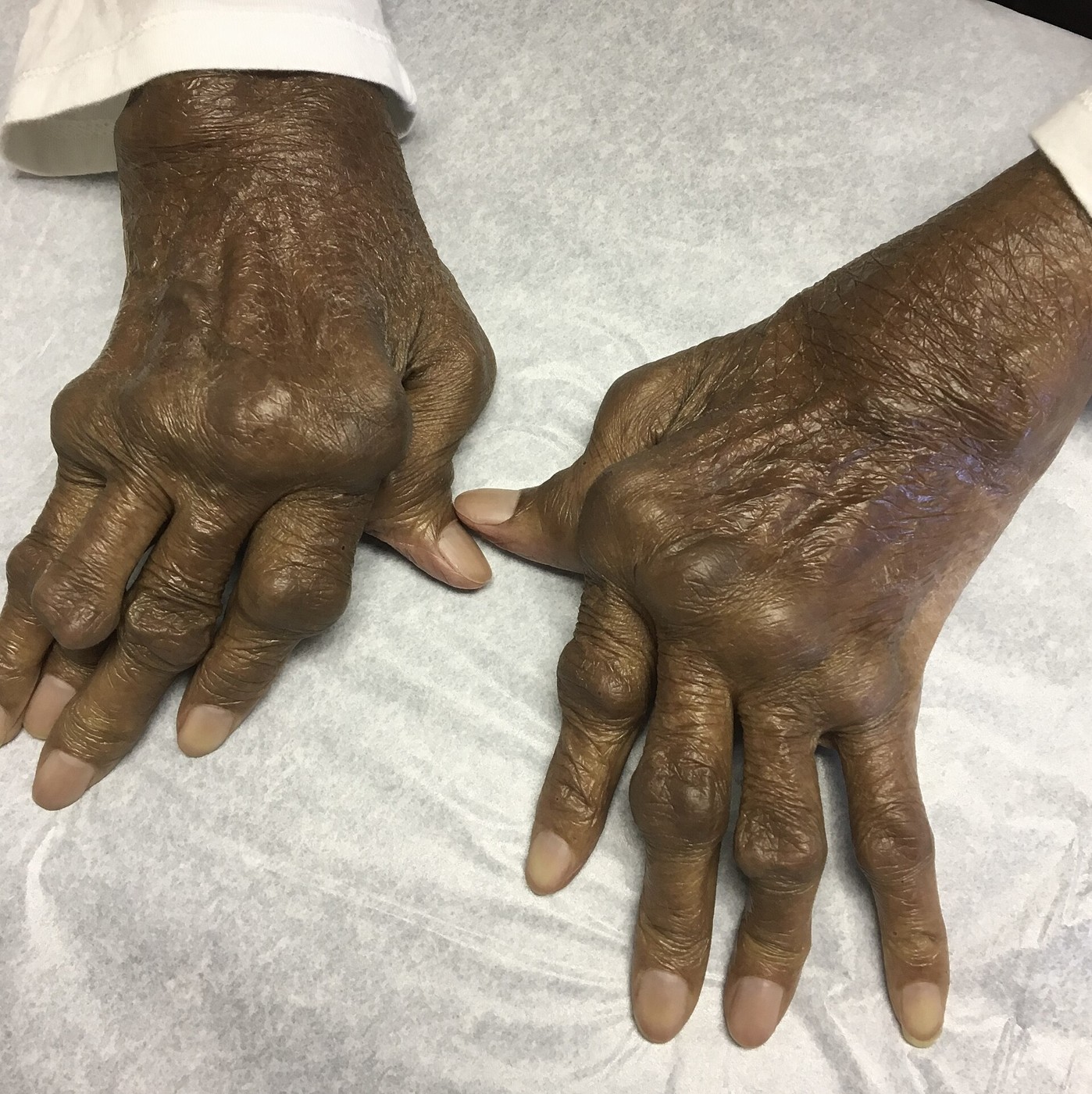
• Synovitis – inspect and palpate for boggy soft-tissue swelling, warmth and tenderness, concentrating on the metacarpophalangeal (MCP), proximal interphalangeal (PIP), wrist and metatarsophalangeal (MTP) joints. |
|
• A positive MCP or MTP squeeze test (tenderness on gentle transverse compression across the knuckles) is a useful early sign of synovitis. |
|
• Assess symmetry and the number of joints involved, and document a baseline of the affected joints. |
|
• Function – grip strength, pincer grip and range of movement. |
|
• Late deformities – ulnar deviation, swan-neck and boutonnière deformities, Z-thumb, subluxation (their absence does not exclude rheumatoid arthritis [RA]). |
|
➤ Extra-articular signs: • Rheumatoid nodules (typically over the olecranon or extensor surfaces) • Eye inflammation • Chest signs • Skin and pulses for vasculitis |
Source: NICE NG100
💬 Patient Explanation
|
Rheumatoid arthritis is a condition where your immune system mistakenly attacks the lining of your joints, causing pain, swelling and stiffness. |
🧪 Investigations
| Test | Indication |
|---|---|
| Rheumatoid factor (RF) | • First-line where synovitis is present • Positive in roughly 60–70% but not specific (also positive in other conditions and some healthy people) • A negative result does not exclude rheumatoid arthritis (RA) |
| Anti-cyclic citrullinated peptide (anti-CCP) antibodies | • More specific than RF • Check if RF is negative • Their presence (or erosions on X-ray) predicts more aggressive, erosive disease |
| CRP and ESR | • Inflammatory markers are often raised but may be normal early • Used in specialist care to monitor activity |
| FBC, U&E, LFTs | Baseline before disease-modifying drugs and for ongoing shared-care monitoring. |
| X-ray of hands and feet | • For baseline erosions and joint-space narrowing • Often normal in early disease, so a normal X-ray does not exclude RA |
|
⚠️ Common pitfall • Letting blood tests decide the referral. • A normal CRP and ESR, or a negative rheumatoid factor, does not exclude RA. • RF has a high false-positive rate when used as a screening test – over-reliance on RF in primary care is well documented. • Refer on the clinical picture. Order investigations in parallel, and never wait for the results before referring. |
Source: NICE NG100
💊 Management
| All patients |
|---|
|
1. Refer urgently to rheumatology – within 3 working days of presentation – for suspected persistent synovitis; do not wait for results. |
|
2. Arrange baseline FBC, U&E, LFTs, anti-CCP (if rheumatoid factor [RF] negative) and X-ray hands/feet – in parallel with referral. |
|
3. Control symptoms while awaiting review with simple analgesia and an NSAID with a proton pump inhibitor (PPI). |
|
4. Avoid starting glucocorticoids before specialist assessment unless advised – they can mask synovitis and obscure the diagnosis. |
|
5. Assess and manage cardiovascular and osteoporosis risk; offer annual influenza and one-off pneumococcal vaccination. |
|
6. Once diagnosed, support shared-care disease-modifying anti-rheumatic drug (DMARD) monitoring and treat-to-target (remission or low disease activity). |
| If severe/urgent |
|---|
|
• Rapidly progressive disease or severe systemic upset → expedite rheumatology review. |
|
🔑 Key principle – refer on suspicion, treat within the window of opportunity • The damage done in early rheumatoid arthritis (RA) is irreversible, and the benefit of disease-modifying therapy is greatest in the first few months. • The job in primary care is not to confirm the diagnosis or stage the disease, but to recognise persistent synovitis and get the patient into specialist care fast. • Investigations run alongside, never ahead of, the referral. |
Source: NICE NG100 · NICE QS33
🧾 Non-pharmacological Treatment
| Intervention | Details |
|---|---|
| Patient education, self-management & psychological support | • Signpost to National Rheumatoid Arthritis Society (NRAS) and Versus Arthritis • Structured self-management improves outcomes and counters misconceptions • Psychological support for living with a chronic disease |
| Smoking cessation | • The most important lifestyle change – smoking worsens disease activity and reduces treatment response • Offer behavioural support and pharmacotherapy |
| Physiotherapy | Tailored exercise, joint protection and maintenance of muscle strength and range of movement. |
| Occupational therapy | Functional assessment, joint-protection techniques, splints and aids/adaptations. |
| Podiatry | Foot care, orthotics and footwear advice for metatarsophalangeal (MTP) involvement. |
| Diet, weight & activity | • Balanced (Mediterranean-style) diet, healthy weight and regular activity within ability |
| Vaccination status | • Keep influenza and pneumococcal vaccination current |
Source: NICE NG100
⚕️ Pharmacological Treatment
| Treatment Options and Escalation |
|---|
|
➤ Interim symptom control in primary care (while awaiting specialist review) |
|
→ NSAID – e.g. naproxen or ibuprofen – at the lowest effective dose for the shortest time, co-prescribed with a proton pump inhibitor (PPI). Take account of gastrointestinal, renal, hepatic and cardiovascular risk. |
|
→ Paracetamol may be added for additional analgesia. |
|
→ Avoid initiating oral glucocorticoids (e.g. prednisolone) before assessment unless advised by rheumatology. Short-term bridging steroids are typically started by the specialist when a new disease-modifying anti-rheumatic drug (DMARD) is commenced. |
|
→ First-line: conventional DMARD (cDMARD) monotherapy with oral methotrexate, leflunomide or sulfasalazine, started as soon as possible (ideally within 3 months of persistent symptoms) and dose-escalated. For mild or palindromic disease, hydroxychloroquine is an alternative. |
|
→ Methotrexate is co-prescribed with folic acid (on a different day) and given ONCE WEEKLY – see the safety alert below. |
|
→ Step-up: add further cDMARDs in combination if the treat-to-target goal is not met. |
|
→ Biological DMARDs (bDMARDs) – e.g. tumour necrosis factor (TNF) inhibitors adalimumab or etanercept – for inadequate response, usually combined with methotrexate. |
|
→ Targeted synthetic DMARDs (tsDMARDs) – Janus kinase (JAK) inhibitors such as baricitinib, tofacitinib or upadacitinib – with important MHRA restrictions (see Special Notes). |
|
→ Glucocorticoids – short courses for flares; long-term use only after all other options and a full discussion of risks. |
Source: NICE NG100 · MHRA Drug Safety Update
📌 Special Notes & DVLA
|
📌 Safety alert – methotrexate is a once-WEEKLY medicine • Methotrexate for rheumatoid arthritis (RA) is taken once a week; inadvertent daily dosing has caused fatal overdose (mucositis, bone-marrow failure, hepatic and renal toxicity). • Record the chosen day of the week in full on every prescription. • Prescribe in 2.5 mg tablet strength only (avoid mixing 2.5 mg and 10 mg tablets). • Co-prescribe folic acid. • Confirm the patient understands the weekly schedule. • Hold methotrexate during significant infection and ensure shared-care monitoring (FBC, LFTs, U&E) is up to date. |
• Pregnancy & conception – methotrexate and leflunomide are teratogenic. Effective contraception and pre-conception counselling are essential. These drugs must be stopped with an appropriate washout (leflunomide requires a cholestyramine washout) before conception. Switch to a pregnancy-compatible agent in conjunction with rheumatology.
• Live vaccines – contraindicated in patients on immunosuppressive disease-modifying antirheumatic drugs (DMARDs) or biologics; complete any required live vaccines before starting therapy where possible.
• Cardiovascular risk – RA is an independent risk factor for cardiovascular disease (CVD). Assess and manage lipids and blood pressure proactively, and review at least annually.
• Janus kinase (JAK) inhibitors – the MHRA advises using these only when no suitable alternative exists in patients aged 65 or over, current or long-term ex-smokers, and those with cardiovascular or malignancy risk factors. Use them with caution if venous thromboembolism (VTE) risk factors are present.
• Driving (DVLA) – RA itself is not separately notifiable. A driver must inform the DVLA if they use adaptive vehicle controls, or if joint or cervical-spine disease (or sedating treatment) affects their ability to drive safely.
Source: NICE NG100 · MHRA Drug Safety Update · DVLA
➡️ Referral Pathways
| Same-day |
|---|
|
• Suspected septic arthritis (hot, immobile, single joint ± fever, or inflamed prosthetic joint) → emergency admission |
|
• Red-flag extra-articular disease (cervical myelopathy, scleritis, vasculitis, acute or rapidly worsening breathlessness or hypoxia) → urgent specialist input |
| Urgent (≤ 3 working days) |
|---|
|
➤ Suspected persistent synovitis → any one of: • Small joints of the hands or feet affected • More than 1 joint involved • A delay of 3 months or more between onset of symptoms and seeking medical advice → urgent rheumatology (do not wait for bloods) |
|
• Established rheumatoid arthritis (RA) with a flare or possible treatment side-effects → contact rheumatology for advice within 1 working day |
| Routine/Supportive |
|---|
|
• Physiotherapy → exercise, joint protection |
|
• Occupational therapy → function, aids, splints |
|
• Podiatry → foot care and orthotics • Psychological support → coping with chronic disease |
Source: NICE NG100 · NICE QS33
🏠 Take Home Messages
• Recognise the pattern – symmetrical small-joint (MCP, PIP and MTP) synovitis with early-morning stiffness over 30 minutes and fatigue, sparing the distal interphalangeal (DIP) joints, in an adult (often a female smoker).
• Refer fast, don't wait for tests – urgent rheumatology referral within 3 working days on clinical suspicion; normal CRP/ESR or a negative rheumatoid factor does not exclude rheumatoid arthritis (RA).
• Exclude septic arthritis – a single hot, immobile joint (± fever) is a medical emergency needing same-day admission, not a referral letter.
• Treat the whole patient – manage cardiovascular and bone health aggressively (RA is an independent risk factor for cardiovascular disease), keep vaccinations current, and signpost self-management.
• Know the drug-safety essentials – methotrexate is WEEKLY (fatal if taken daily) with folic acid cover and is teratogenic; Janus kinase (JAK) inhibitors carry MHRA cautions for cardiovascular, malignancy and venous thromboembolism (VTE) risk.
Source: NICE NG100 · NICE QS33 · MHRA Drug Safety Update
|
🧭 AKT – high-yield facts • Urgent referral (within 3 working days) for suspected persistent synovitis if the small joints of the hands/feet are affected, more than one joint is involved, or there has been a delay of 3 months or more between onset of symptoms and seeking medical advice. • Referral is on clinical grounds, even with normal bloods. • Rheumatoid factor is positive in ~60–70% (not specific); check anti-CCP if RF negative – anti-CCP (or X-ray erosions) predicts erosive disease. • First-line is cDMARD monotherapy (methotrexate, leflunomide or sulfasalazine; hydroxychloroquine for mild/palindromic disease), escalating to step-up combinations; treat-to-target (remission or low disease activity). • Methotrexate is taken ONCE WEEKLY with folic acid – daily dosing can be fatal – and is teratogenic. • A single hot, red, immobile joint (± fever) is septic arthritis until proven otherwise → same-day admission. • Extra-articular RA: rheumatoid nodules, interstitial lung disease (ILD), scleritis/episcleritis, vasculitis, cervical myelopathy/atlanto-axial subluxation, Felty's syndrome; RA is an independent cardiovascular risk factor. • JAK inhibitors: avoid unless there is no suitable alternative in those aged 65 or over, current or long-term ex-smokers, or those with cardiovascular or malignancy risk factors. Use with caution if venous thromboembolism (VTE) risk factors are present (MHRA, 2023). |
|
🎯 SCA A 32-year-old woman with recently diagnosed RA, started on methotrexate by rheumatology two months ago, books an appointment to “sort out contraception.” During the consultation she mentions that she and her partner are hoping to start a family later this year. The dilemma: methotrexate is teratogenic and must be stopped – with an adequate washout – before conception, and reliable contraception is needed in the meantime. Yet stopping risks a disease flare in a condition only just brought under control. A strong consultation: • Explores her ideas, concerns and expectations – what she understands about methotrexate and pregnancy, and what becoming a parent means to her. • Explains, sensitively and without alarm, why methotrexate must be stopped before conception and the need to plan a switch to a pregnancy-compatible drug. • Makes a shared plan involving prompt liaison with rheumatology, interim reliable contraception, folic acid and pre-conception counselling. • Gives clear safety-nets – what to do in a flare, who to contact, and to avoid conceiving until the team confirms it is safe. • Respects her autonomy and supports her goals throughout. |
📎Reference: NICE NG100. Rheumatoid arthritis in adults: management. Available from: https://www.nice.org.uk/guidance/ng100
📎Reference: NICE QS33. Rheumatoid arthritis in over 16s (quality standard). Available from: https://www.nice.org.uk/guidance/qs33
📎Reference: NICE CKS. Rheumatoid arthritis. Available from: https://cks.nice.org.uk/topics/rheumatoid-arthritis/
📎Reference: MHRA Drug Safety Update. Methotrexate once-weekly for autoimmune diseases: new measures to reduce risk of fatal overdose due to inadvertent daily instead of weekly dosing. Available from: https://www.gov.uk/drug-safety-update/methotrexate-once-weekly-for-autoimmune-diseases-new-measures-to-reduce-risk-of-fatal-overdose-due-to-inadvertent-daily-instead-of-weekly-dosing
📎Reference: MHRA Drug Safety Update. Janus kinase (JAK) inhibitors: new measures to reduce risks of major cardiovascular events, malignancy, venous thromboembolism, serious infections and increased mortality. Available from: https://www.gov.uk/drug-safety-update/janus-kinase-jak-inhibitors-new-measures-to-reduce-risks-of-major-cardiovascular-events-malignancy-venous-thromboembolism-serious-infections-and-increased-mortality
📎Reference: National Rheumatoid Arthritis Society (NRAS). Information and support for rheumatoid arthritis. Available from: https://nras.org.uk/information-support/information/
Three whole topics are free to read. Every topic opens with a free account.
Your CPD is counted as you read, and kept from the day you join.
Join us, it’s free