 GPAtlas
🧭 When to suspect
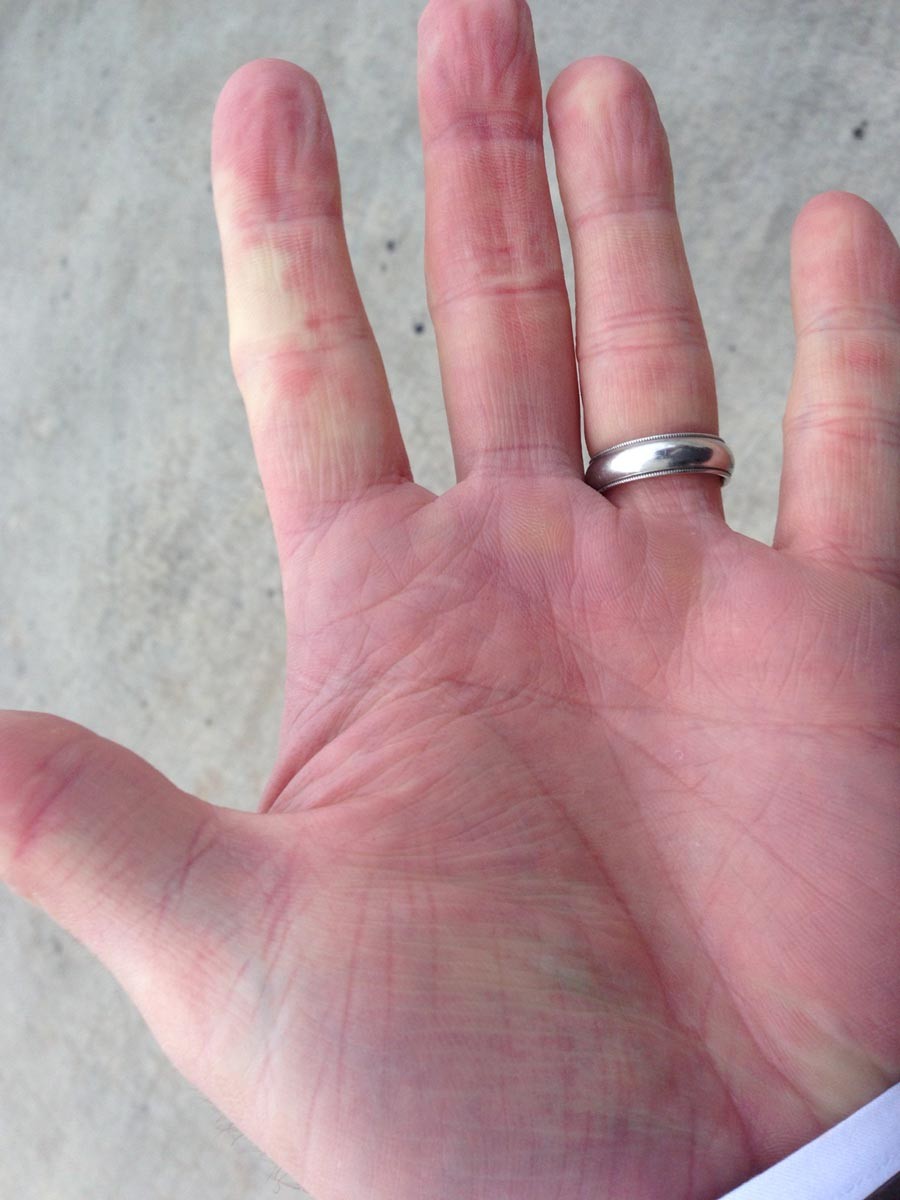
Raynaud's phenomenon (RP) is episodic, reversible vasospasm of the digital arteries and arterioles, producing sharply demarcated colour change in the fingers and toes.
• Classically triphasic: pallor (white, ischaemia), then cyanosis (blue, deoxygenation), then rubor (red, reperfusion) – although not every attack runs the full sequence.
• Attacks are provoked by cold or emotional stress, with accompanying numbness, tingling or pain that is most marked on rewarming.
• Raynaud's is common, affecting around 1 in 10 people in the UK.
Separate primary Raynaud's (idiopathic and benign) from secondary Raynaud's (a marker of an underlying disorder, most importantly connective tissue disease). Suspect the secondary form whenever onset is late, attacks are asymmetrical, or there is any tissue damage.
| Feature | Primary Raynaud's | Secondary Raynaud's |
|---|---|---|
| Typical onset | Adolescence to 20s (under 30) | Over 30 – especially over 40, and in men |
| Sex | Up to 9× more common in women | Either sex |
| Symmetry | Symmetrical (both hands) | May be asymmetrical |
| Thumb | Usually spared | May be involved |
| Tissue damage | None (no ulcers or pitting scars) | Digital pitting, ulcers or gangrene possible |
| Nailfold capillaries | Normal | Dilated loops or capillary dropout |
| Antinuclear antibody | Negative | Often positive (with specific antibodies) |
| Underlying cause | • None • Family history common |
Connective tissue disease, drugs, occupational |
Causes of secondary Raynaud's fall into these groups:
• Underlying connective tissue disease: systemic sclerosis (the commonest and most important), systemic lupus erythematosus (SLE), mixed connective tissue disease (MCTD), Sjögren's, dermatomyositis and rheumatoid arthritis (RA).
• Some drugs: beta-blockers, sympathomimetic decongestants, ergot and triptan migraine therapies, and certain chemotherapy agents.
• An occupational cause: hand-arm vibration syndrome (HAVS) from vibrating tools.
• A haematological cause: cryoglobulinaemia, polycythaemia and paraproteinaemia.
• An endocrine cause: hypothyroidism.
Smoking aggravates every form.
Source: British Society for Rheumatology
🩺 History
| Ask about symptoms |
|---|
|
• Confirm sharply demarcated colour change (white → blue → red) in the fingers or toes? |
|
• Establish the triggers – cold air or water, handling frozen items, emotional stress? |
|
• Ask about accompanying numbness, tingling or throbbing pain, especially on rewarming? |
|
• Clarify whether attacks are symmetrical or asymmetrical, and whether the thumb is ever involved? |
|
• Ask about any permanent skin changes, sores or pitting scars on the fingertips? |
|
• Establish frequency, duration and seasonal pattern of attacks? |
| Ask about risk factors and modifiers |
|---|
|
• Determine the age of onset – under 30 favours primary, over 30 favours secondary? |
|
• Screen for connective tissue disease symptoms – joint pain, rashes, dysphagia, dry eyes or mouth, muscle weakness? |
|
• Take an occupational history – vibrating tools (hand-arm vibration syndrome), chemical exposure? |
|
• Review the drug chart – beta-blockers, decongestants, ergot or triptan migraine drugs, chemotherapy? |
|
• Ask about smoking – a vasoconstrictor that aggravates attacks? |
|
• Explore family history of Raynaud's or autoimmune disease? |
| 🧩 Patient Perspective |
|---|
|
➤ "Ask how frequent and severe the episodes are, and how they affect work, hobbies and daily life?" |
|
➤ "Explore the patient's current strategies for keeping warm and any practical barriers – for example an outdoor job or a cold workplace?" |
Source: British Society for Rheumatology
⚠️ Red Flags
| Escalation criteria |
|---|
|
➤ Critical digital ischaemia → any one of: • Severe persistent pain • Non-healing digital ulcer • Gangrene • Necrosis → vascular emergency → same-day referral to vascular/rheumatology, to be seen within 48 hours |
|
➤ New tissue necrosis in established Raynaud's → severe digital vasculopathy → specialist assessment within 48 hours |
|
➤ Sudden, asymmetrical, painful digital ischaemia → possible thromboembolism or large-vessel disease → urgent vascular review |
|
➤ Onset over 40, especially in a man → higher probability of an underlying secondary cause → investigate and refer |
|
➤ Digital pitting scars, ulceration, or abnormal nailfold capillaries → features of connective tissue disease → rheumatology referral |
|
➤ Systemic features: • Sclerodactyly • Telangiectasia • Malar or heliotrope rash • Dysphagia • Dry eyes or mouth • Proximal muscle weakness • Synovitis → suggestive of connective tissue disease → rheumatology referral |
Source: British Society for Rheumatology
🔎 Examination
| Examination findings and signs |
|---|
|
• Inspect the hands and feet for colour change, digital pitting scars, ulcers or gangrene – though the hand is usually normal between attacks. |
|
• Palpate peripheral pulses (radial, ulnar, brachial, pedal) and consider Allen's test – to detect large-vessel disease. |
|
• Skin – look for tightening (sclerodactyly), a shiny tethered appearance, calcinosis or telangiectasia, suggesting systemic sclerosis. |
|
• Nailfold capillaries – examine with a dermatoscope or ophthalmoscope for dilated loops or capillary dropout (a marker of secondary disease). |
|
• Joints and face – check for synovitis or deformity, and for a malar or heliotrope rash. |
|
🧠 Clinical pearl • Thumb sparing is the rule in primary Raynaud's. • The thumb has a relatively rich collateral blood supply, so its involvement is unusual and points towards a secondary, structural or connective-tissue cause. • Examine the thumb specifically and ask the patient whether it is ever affected – an easily missed discriminator. |
Source: British Society for Rheumatology
💬 Patient Explanation
|
Raynaud's is where the small blood vessels in your fingers and toes overreact to cold or stress and squeeze shut, briefly cutting off the blood supply. |
🧪 Investigations
| Test | Indication |
|---|---|
| FBC, ESR, CRP | Screen for anaemia, cytopenias or raised inflammatory markers seen in connective tissue disease. |
| Antinuclear antibody (ANA) | • First-line autoantibody screen • A positive result raises the probability of an underlying autoimmune disorder (systemic sclerosis, systemic lupus erythematosus [SLE]) |
| Extractable nuclear antigen (ENA) panel, rheumatoid factor (RF), anti-cyclic citrullinated peptide (anti-CCP), systemic sclerosis-specific antibodies | • Second-line – guided by a positive ANA or strong suspicion • Anti-centromere and anti-Scl-70 antibodies point to systemic sclerosis |
| U&E, LFTs, TFTs, urinalysis | Assess for renal or hepatic involvement in multisystem disease, and for thyroid disease (an associated cause). |
| Nailfold capillaroscopy – specialist-initiated | • Examines the capillaries at the nail base • Abnormal patterns are central to diagnosing systemic sclerosis |
Source: British Society for Rheumatology
💊 Management
| All patients |
|---|
|
1. Establish whether Raynaud's is primary or secondary – this single distinction drives everything that follows. |
|
2. Primary Raynaud's → reassure, advise whole-body warmth and trigger avoidance, and review medications. |
|
3. Refer critical digital ischaemia the same day to vascular/rheumatology, and suspected secondary Raynaud's to rheumatology with an autoimmune work-up. |
|
4. Support smoking cessation and optimise cardiovascular risk. |
|
5. Offer drug treatment (first-line nifedipine) only if conservative measures fail to control symptoms. |
|
6. Consider periodically pausing medication in primary Raynaud's, as the condition may remit. |
| If severe/urgent |
|---|
|
• Severe refractory ischaemia or digital ulcers → specialist vasodilator therapy (e.g. intravenous prostanoids). |
|
🔑 Key principle – separate the benign from the sinister • Most Raynaud's is primary, idiopathic and harmless, needing only reassurance, warmth and (occasionally) nifedipine. • The clinical priority is to spot the minority whose Raynaud's is the presenting sign of a connective tissue disease, and to investigate and refer them to rheumatology. • Look for late onset, asymmetry, tissue damage, abnormal nailfolds or a positive antinuclear antibody. • Raynaud's can precede systemic sclerosis by years. |
Source: British Society for Rheumatology
🧾 Non-pharmacological Treatment
| Intervention | Details |
|---|---|
| Whole-body warmth | • The core intervention – keep the trunk warm with layers, plus gloves, warm socks and a hat • Pocket or battery hand-warmers help • Warming the core, not just the hands, both aborts and prevents attacks |
| Trigger avoidance | • Avoid sudden temperature drops (freezer aisles, air-conditioning) • Wear gloves to handle frozen food or to drive in winter |
| Smoking cessation | • Nicotine is a vasoconstrictor • Refer to stop-smoking services • Nicotine replacement is safer than smoking but is not entirely neutral |
| Stress management | Relaxation techniques and stress reduction lessen emotionally-triggered attacks. |
| Regular exercise | Improves general circulation and cardiovascular fitness. |
| Medication review | Identify and, where safe, stop or switch vasoconstrictor drugs (beta-blockers, decongestants, ergot or triptan migraine therapies). |
Source: British Society for Rheumatology
⚕️ Pharmacological Treatment
| Treatment Options and Escalation |
|---|
|
➤ First-line in primary care – calcium channel blocker (CCB) |
|
→ Nifedipine is the agent of choice and the only calcium channel blocker licensed for Raynaud's. A modified-release (MR) preparation is usually better tolerated, though MR is used off-label for this indication. |
|
→ Titrate from a low dose to effect – e.g. nifedipine MR up to 60 mg once daily, or immediate-release (IR) up to 20 mg three times daily, as tolerated. Some patients take it only through the winter months. |
|
→ If nifedipine is not tolerated, consider nicardipine, amlodipine or felodipine. |
|
→ Counsel on vasodilatory side effects – headache, facial flushing, ankle oedema, dizziness and palpitations – which usually settle with continued use. |
|
➤ Specialist therapies – secondary, severe or refractory disease (specialist-only) |
|
→ Other vasodilators: sildenafil or tadalafil (phosphodiesterase type 5 [PDE-5] inhibitors), losartan (an angiotensin receptor blocker [ARB]), or fluoxetine (a selective serotonin reuptake inhibitor [SSRI]). |
|
→ For digital ulcers in systemic sclerosis: sildenafil or tadalafil first-line for healing and prevention → Bosentan second-line → Consider antiplatelet therapy |
|
→ Intravenous prostanoids (e.g. iloprost) for critical ischaemia or severe, non-healing ulcers. |
|
→ Digital (palmar) sympathectomy, with or without botulinum toxin, for refractory cases. |
|
⚠️ Common pitfall • Starting nifedipine without considering pregnancy. • Primary Raynaud's predominantly affects young women. • Nifedipine is generally avoided in pregnancy (some brands are contraindicated; check the Summary of Product Characteristics [SmPC]). • It is contraindicated within one month of a myocardial infarction. • Breastfeeding is not a contraindication, as only small amounts reach the baby. • Check pregnancy plans and blood pressure before prescribing. • Warn that vasodilatory headache and flushing are common in the first few days. |
Source: British Society for Rheumatology
📌 Special Notes
|
📌 Safety – critical digital ischaemia is a vascular emergency • A digit that is persistently painful, dusky, ulcerated or developing gangrene represents critical ischaemia or severe digital vasculopathy. • Critical ischaemia is an emergency: make a same-day referral to vascular/rheumatology, to be seen within 48 hours. • Do not wait for routine investigations. |
• No DVLA notification – Raynaud's phenomenon is not a notifiable condition and imposes no driving restriction. Advise warm gloves and a pre-warmed car in cold weather, for comfort and to reduce attacks while driving.
• Raynaud's can precede systemic sclerosis by years – around 95% of people with systemic sclerosis report Raynaud's as their first symptom. Reassuringly, only a small minority of people with Raynaud's (well under 1 in 10) ever develop scleroderma.
• Hand-arm vibration syndrome – occupational Raynaud's from vibrating tools is a reportable industrial disease. Refer to occupational medicine and advise on tool use and exposure limits.
• A single examination cannot exclude secondary disease – a normal hand between attacks is expected; base the primary-versus-secondary judgement on onset, symmetry, nailfolds and autoantibodies.
• Consider the differential – persistent (non-episodic) discolouration without sharp demarcation suggests an alternative diagnosis, such as chilblains or acrocyanosis.
Source: British Society for Rheumatology · DVLA
➡️ Referral Pathways
| Same-day/Urgent |
|---|
|
• Critical digital ischaemia (severe pain, ulcer, gangrene) → same-day referral to vascular/rheumatology, to be seen within 48 hours |
|
• Sudden asymmetrical digital ischaemia → urgent vascular review |
| Routine rheumatology |
|---|
|
• Suspected secondary Raynaud's – late onset, asymmetry, positive antinuclear antibody (ANA), systemic features → rheumatology referral and autoimmune work-up |
|
• Diagnostic uncertainty or symptoms poorly controlled despite treatment → rheumatology |
| Other |
|---|
|
• Work-related Raynaud's or hand-arm vibration syndrome → occupational medicine |
|
• Uncomplicated primary Raynaud's responding to primary-care measures → no referral needed |
Source: British Society for Rheumatology
🏠 Take Home Messages
• Separate primary from secondary – primary Raynaud's starts young (under 30), is symmetrical, spares the thumb and causes no tissue damage; secondary starts later, may be asymmetrical, and can cause pitting scars or ulcers.
• Examine the nailfolds, pulses and thumb – abnormal nailfold capillaries, absent pulses or thumb involvement point to a secondary cause and warrant a connective tissue disease work-up (starting with antinuclear antibody).
• Warm the whole body, not just the hands – core cooling drives peripheral vasoconstriction, so layers, a hat and warm footwear matter as much as gloves.
• Review the drug chart – deprescribe vasoconstrictors (beta-blockers, decongestants, ergot or triptan migraine drugs) and support smoking cessation.
• Nifedipine is first-line if lifestyle fails – use a modified-release preparation, titrate to tolerance, and remember it is generally avoided in pregnancy.
Source: British Society for Rheumatology
|
🧭 AKT – high-yield facts • Triphasic colour change: pallor (white) → cyanosis (blue) → rubor (red), provoked by cold or stress. • Primary Raynaud's: female predominance, onset under 30, symmetrical, normal nailfolds, negative antinuclear antibody, no tissue damage. • Secondary Raynaud's: onset over 30 (especially men), asymmetrical, digital ulcers or pitting, abnormal nailfold capillaries, positive autoantibodies. • Causes of secondary Raynaud's: most commonly systemic sclerosis (the classic association), but also systemic lupus erythematosus (SLE), drugs and hand-arm vibration syndrome. • In systemic sclerosis, Raynaud's is the first symptom in around 95% – the classic triad is Raynaud's, puffy fingers and a positive antinuclear antibody (ANA). • First-line drug: nifedipine (the only licensed calcium channel blocker); generally avoided in pregnancy. • Critical digital ischaemia (ulcer or gangrene) is a vascular emergency. |
|
🎯 SCA A 26-year-old woman attends with a three-year history of her fingers going white, then blue, then red in the cold, with no ulcers and a normal examination. She has read online that this can be a sign of scleroderma and is frightened. She also mentions that she and her partner are trying to conceive, and that a friend told her there is "a tablet for it". The challenge is to provide accurate reassurance without dismissing a genuine fear, while navigating a prescribing decision complicated by her plans for pregnancy. A strong consultation: • Explores her ideas, concerns and expectations, especially the dread of scleroderma. • Explains, honestly and proportionately, that her picture fits benign primary Raynaud's and that only a small minority ever develop scleroderma. • Makes a shared plan centred on whole-body warmth and trigger avoidance. • Explains why nifedipine is best avoided while trying to conceive. • Clearly safety-nets to return if she develops finger ulcers, skin tightening, or joint or swallowing symptoms – the features that would prompt antibody testing and referral. |
📎Reference: NICE CKS. Raynaud's phenomenon. Available from: https://cks.nice.org.uk/topics/raynauds-phenomenon/
📎Reference: British Society for Rheumatology. The 2024 British Society for Rheumatology guideline for the management of systemic sclerosis. Rheumatology (Oxford) 2024;63(11):2956. Available from: https://academic.oup.com/rheumatology/article/63/11/2956/7750184
📎Reference: NIHR Evidence. Calcium channel blockers are useful in managing Raynaud's phenomenon. Available from: https://evidence.nihr.ac.uk/alert/calcium-channel-blockers-are-useful-in-managing-raynauds-phenomenon/
📎Reference: Scleroderma & Raynaud's UK (SRUK). What is Raynaud's? Available from: https://www.sruk.co.uk/about-raynauds/what-is-raynauds/
Three whole topics are free to read. Every topic opens with a free account.
Your CPD is counted as you read, and kept from the day you join.
Join us, it’s free