 GPAtlas
🧭 When to suspect
Male pattern hair loss (androgenetic alopecia) is the commonest cause of hair loss in men, affecting around half of men by 50 and the majority by 70.
• Androgenetic alopecia is an androgen-dependent, genetically determined process.
• In susceptible follicles, dihydrotestosterone (DHT) – produced from testosterone by the enzyme 5-alpha reductase – drives progressive follicular miniaturisation.
• Each successive hair grows finer, shorter and less pigmented until the follicle stops producing a visible hair.
The diagnosis is clinical.
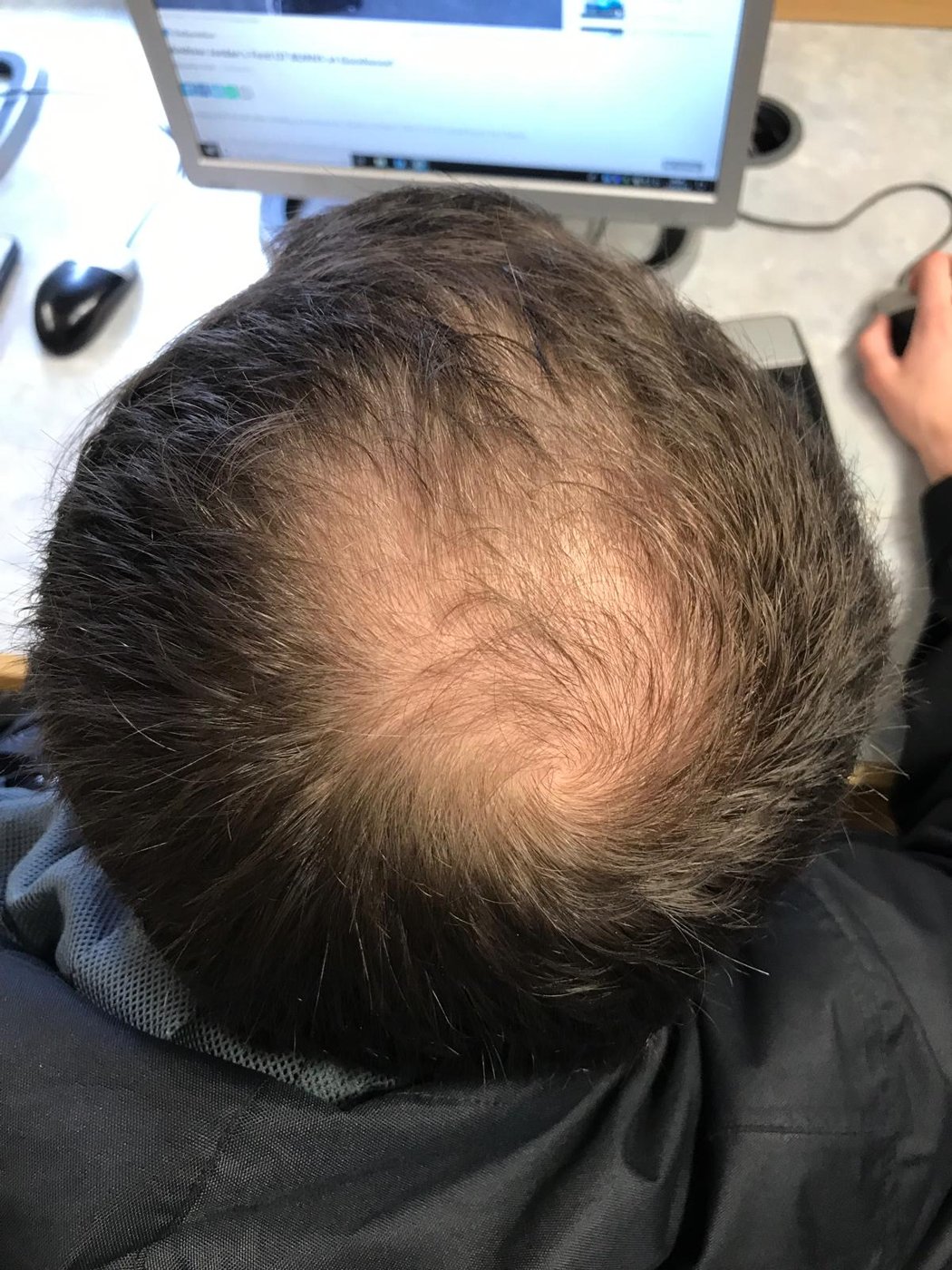
• Suspect it in a man describing gradual, painless thinning with bitemporal recession of the hairline and loss over the crown (vertex).
• The scalp is otherwise normal – no scaling, no inflammation and no scarring.
• Around one in ten men instead show a “female” pattern: diffuse thinning over the crown with a widening central parting but a preserved frontal hairline.
The two practical skills in primary care are to recognise the typical pattern confidently – sparing unnecessary investigation – and to spot the features that point to a different cause, some of which are reversible or follicle-destroying.
| Presentation | Suggests |
|---|---|
| Gradual bitemporal recession and vertex thinning on a non-inflamed, non-scarred scalp | Male pattern hair loss (androgenetic alopecia) |
| Diffuse shedding 2–3 months after a trigger (illness, surgery, childbirth, crash diet, severe stress) | Telogen effluvium – usually self-limiting |
| Well-defined, smooth, round bald patches ± short tapering “exclamation-mark” hairs | Alopecia areata |
| Redness, scaling, pustules, or loss of follicular openings with scarring | • Cicatricial (scarring) alopecia – irreversible • Refer early |
| Frontal hairline recession with eyebrow loss, typically in a post-menopausal woman | Frontal fibrosing alopecia |
| Loss confined to the margins or sites of tight or pulled hairstyles | Traction alopecia |
🩺 History
| Ask about symptoms |
|---|
|
• Establish the onset and speed of the hair loss – gradual (typical) or sudden? |
|
• Clarify whether this is shedding (hairs falling out, often after a trigger) or thinning (reduced density and calibre)? |
|
• Determine which areas are affected – temples, crown, or diffuse across the scalp? |
|
• Ask about scalp symptoms – tenderness, pain, burning, or itch (point away from simple pattern loss)? |
|
• Ask about loss of eyebrows, eyelashes or body hair (suggests an alternative diagnosis)? |
| Ask about risk factors and modifiers |
|---|
|
• Take a family history of hair loss, on either the maternal or paternal side? |
|
• Ask about past medical history – thyroid disease, other endocrine or autoimmune conditions, recent significant illness? |
|
• Review the drug history for agents linked to hair loss – anticoagulants, some antidepressants, carbimazole, beta-blockers, retinoids? |
|
• Check for rapid weight loss, dieting, fasting or restricted intake (triggers for telogen effluvium and nutritional deficiency)? |
|
• Explore recent stressors, surgery or childbirth in the preceding few months? |
| 🧩 Patient Perspective |
|---|
|
➤ "Ask about the psychological impact of the hair loss – how it affects mood, confidence, relationships and day-to-day life?" |
|
➤ "Explore the patient's hair-care routine, any styling changes made to disguise the loss, and what they are hoping treatment can achieve?" |
⚠️ Red Flags
| Features pointing away from simple pattern loss |
|---|
|
➤ Inflammation or scarring → any one of: • Papules • Pustules • Scaling • Redness • Loss of follicular openings → suspected cicatricial alopecia → refer early to preserve follicles |
|
➤ Rapid or profound shedding → telogen or anagen effluvium → identify and address the trigger |
|
➤ Loss of eyebrows or eyelashes → frontal fibrosing alopecia or alopecia areata |
|
➤ Patchy, well-demarcated bald areas → alopecia areata (look for exclamation-mark hairs) |
|
➤ Systemic clues (features of iron deficiency or thyroid disease, or recent severe illness) → investigate the underlying cause |
|
➤ Marked psychological distress → any one of: • Low mood • Anxiety • Impact on functioning → offer support and consider onward referral |
🔎 Examination
| Examination findings and signs |
|---|
|
• Inspect the scalp for papules, pustules, scaling, redness, or scarring – their presence excludes simple pattern loss and points to an inflammatory or scarring cause. |
|
• Assess the pattern – bitemporal recession and vertex thinning with retained occipital hair; the Hamilton–Norwood scale grades severity and tracks progression. |
|
• Hair pull test – gently grasp and pull a small bunch of hairs; extraction of more than a few (a positive test) indicates active shedding such as telogen effluvium. Most reliable in experienced hands. |
|
• Examine eyebrows, eyelashes and body hair – widespread loss suggests alopecia areata variants rather than androgenetic alopecia. |
|
⚠️ Common pitfall • Labelling an inflamed or scarred scalp as pattern hair loss. • Perifollicular redness, pustules, scaling or loss of the follicular openings signal a cicatricial (scarring) alopecia, where follicle destruction is permanent. • Reassurance and a topical product delay the early dermatology referral and treatment that could have saved hair. • If the scalp is not normal, do not treat it as androgenetic alopecia. |
💬 Patient Explanation
|
Male pattern hair loss is a very common, inherited type of hair loss that usually comes on slowly over years. |
🧪 Investigations
Typical pattern hair loss needs no investigation. Reserve bloods for diffuse, atypical, rapid or female-pattern presentations, where the aim is to exclude a contributing or alternative cause.
| Test | Indication |
|---|---|
| Thyroid function tests (TFTs) | If thyroid disease is suspected, or the presentation is diffuse or atypical. |
| FBC | If anaemia or telogen effluvium (generalised shedding) is suspected. |
| Ferritin | To identify iron deficiency as a driver of diffuse shedding. |
| Vitamin D | Consider if deficiency is clinically suspected as a contributing factor. |
| Dermoscopy/trichoscopy & scalp biopsy – specialist-initiated | Used in secondary care to distinguish alopecia subtypes and confirm scarring alopecia. |
💊 Management
| All patients |
|---|
|
1. Confirm the clinical diagnosis and explain the natural course – progression is usually slow but continuous. |
|
2. Exclude mimics: refer an inflamed or scarred scalp to dermatology early. |
|
3. Reassure that frequent washing does not cause or worsen the loss. |
|
4. Discuss the options – no treatment, cosmetic aids, medication, or surgery – and set realistic expectations. |
|
5. Signpost to Alopecia UK for reliable information and peer support. |
|
🔑 Key principle – it is cosmetic, lifelong, and self-funded • For androgenetic alopecia, the medical job is to confirm the diagnosis, exclude mimics, and manage expectations. • There is no cure: treatment slows progression and may partially thicken hair, and works only while continued. • For both minoxidil and finasteride, treatment is not funded by the NHS for this indication. • Naming this early prevents disappointment and avoids futile prescribing requests. |
🧾 Non-pharmacological Treatment
| Intervention | Details |
|---|---|
| Acceptance & reassurance | For many men, an explanation that this is benign and common, with no treatment, is an entirely reasonable choice. |
| Cosmetic camouflage | • Styling, hair-coloured sprays and keratin fibre products • Hair extensions carry a risk of traction alopecia if worn tightly |
| Wigs & hairpieces | • An option for extensive loss • NHS provision is limited and usually reserved for marked hair loss, with eligibility and any charges varying locally |
| Hair transplantation | • Follicular unit techniques can redistribute hair • Performed privately and not available on the NHS |
| Psychological support | Counselling, peer support (Alopecia UK), or NHS Talking Therapies where hair loss causes significant distress. |
⚕️ Pharmacological Treatment
| Treatment Options and Escalation |
|---|
|
➤ Important – neither agent is NHS-funded for androgenetic alopecia. Minoxidil is bought over-the-counter (OTC); finasteride 1 mg is obtained on private prescription. |
|
➤ Topical minoxidil (5%) – a vasodilator that prolongs the growth (anagen) phase; first-line, OTC. |
|
→ 5% foam (e.g. Regaine for Men Extra Strength): licensed for men aged 18–49, applied to the dry scalp once daily. |
|
→ 5% solution: licensed for men aged 18–65, 1 mL twice daily. |
|
→ Counselling: • Warn of a transient increase in shedding in the first weeks (expected, not a reason to stop) • Possible scalp irritation and unwanted facial hair • Assess response at ~4 months for the foam, or at about a year for the solution • Full effect may take up to a year |
|
➤ Oral finasteride 1 mg (e.g. Propecia) – a 5-alpha reductase inhibitor that lowers scalp dihydrotestosterone (DHT); the licensed product for male pattern hair loss (private prescription only). |
|
→ Safety: associated with depression, suicidal ideation and sexual dysfunction that may persist after stopping – counsel before starting and review regularly (see Special Notes). Proscar 5 mg and tablet-splitting are off-label. |
|
→ Teratogenic: women who are or may become pregnant must not handle crushed or broken tablets (risk of harm to a male fetus). |
|
➤ Specialist-only options |
|
→ Low-dose oral minoxidil and dutasteride are used off-label/unlicensed in the UK and should be initiated only by a clinician experienced in managing alopecia. |
|
➤ General principles for drug treatment |
|
→ Response is variable; treatment must be continued indefinitely, and any benefit is lost within 6–12 months of stopping. Discontinue if there is no response after about a year (4 months for minoxidil foam). |
|
🧠 Clinical pearl • Finasteride lowers serum prostate-specific antigen (PSA) by roughly half. • When interpreting a PSA in a man taking finasteride (at either the 1 mg or 5 mg dose), double the measured value before comparing it with the age-specific reference range. • Otherwise a clinically significant prostate cancer can be masked. |
📌 Special Notes & Safety
|
📌 Safety alert – finasteride (MHRA Drug Safety Update) • The Medicines and Healthcare products Regulatory Agency (MHRA) links finasteride to depression, suicidal ideation, and sexual dysfunction (reduced libido, erectile dysfunction, ejaculation disorders) that may persist after the drug is stopped. • Before prescribing, review the record and ask about any history of depression or suicidal ideation; review the patient regularly for psychiatric and sexual side effects. • A patient alert card is included in every pack – direct the patient to read it and the leaflet, and to share them with family who may notice mood changes. • Advise the patient to stop finasteride 1 mg immediately and contact a clinician if they develop low mood or suicidal thoughts, and to seek emergency help (999) if at risk of serious self-harm. Report suspected reactions via the Yellow Card scheme. |
• Not on the NHS – minoxidil and finasteride for androgenetic alopecia are not NHS-funded; set this expectation early to avoid futile prescribing requests.
• The “female” pattern in men – around one in ten men present with diffuse crown thinning and a retained frontal hairline rather than classic recession.
• Diagnosis is clinical – typical pattern loss needs no bloods; reserve investigation for diffuse, atypical or inflammatory presentations.
• Online and private supply – many men access finasteride through online services; ask directly about it, as patients may not volunteer a privately purchased medicine.
➡️ Referral Pathways
| Refer early/soon |
|---|
|
• Suspected scarring (cicatricial) alopecia – inflammation, pustules, scaling, or loss of follicular openings → dermatology, to preserve remaining follicles |
|
• Rapid or extensive unexplained loss → dermatology |
|
• Significant psychological distress – anxiety or low mood → NHS Talking Therapies or psychological support |
| Routine or primary care |
|---|
|
• Diagnostic uncertainty or atypical pattern → dermatologist with an interest in hair |
|
• No response to an adequate treatment trial (about a year, or 4 months for minoxidil foam) → dermatology |
|
• Suspected underlying cause (e.g. thyroid disease, iron deficiency) → investigate and manage in primary care |
🏠 Take Home Messages
• Diagnose clinically by pattern – gradual bitemporal recession and vertex thinning on a non-inflamed, non-scarred scalp is androgenetic alopecia and rarely needs investigation.
• Actively exclude the mimics – diffuse shedding after a trigger (telogen effluvium), smooth patchy loss (alopecia areata), and especially inflammation or scarring (cicatricial alopecia, which destroys follicles permanently and needs early referral).
• Set expectations honestly – neither minoxidil nor finasteride is available on the NHS, and treatment slows progression and may partially thicken hair rather than restoring a full head.
• Counsel on finasteride safety – the MHRA links it to depression, suicidal ideation and persistent sexual dysfunction; ask about mood, point to the patient alert card, and advise stopping the 1 mg dose if mood symptoms develop.
• Commit to the long term – both treatments must be continued indefinitely, as any benefit is lost within 6–12 months of stopping.
|
🧭 AKT – high-yield facts • Androgenetic alopecia is driven by dihydrotestosterone (DHT) acting on genetically susceptible follicles via 5-alpha reductase, causing follicular miniaturisation; severity is graded on the Hamilton–Norwood scale. • The diagnosis is clinical; typical cases need no bloods. Check FBC, ferritin and thyroid function tests (TFTs) only for diffuse, atypical or female-pattern presentations. • Topical minoxidil 5% is bought over-the-counter (OTC); oral finasteride 1 mg (Propecia) is private-prescription only – neither is NHS-funded for this indication. • Finasteride lowers prostate-specific antigen (PSA) by ~50% – double the measured value when assessing prostate cancer risk in a man taking it. • MHRA safety: finasteride is linked to depression, suicidal ideation and sexual dysfunction that may persist after stopping; patients on the 1 mg dose should stop if mood symptoms develop. • Both drugs require indefinite use; benefit is lost within 6–12 months of stopping. Inflammation or scarring suggests cicatricial alopecia – irreversible, refer early. |
|
🎯 SCA A 29-year-old man books a routine appointment to talk about his hair. Six months ago, worried about a receding hairline, he started finasteride 1 mg bought from an online pharmacy. His hair has stabilised and he is pleased – but over the last few weeks he has noticed a lower sex drive and feels his mood has dipped, and he is anxious that stopping the tablets will undo the improvement. The dilemma is genuine: his hair loss matters deeply to his confidence and he is reluctant to stop, yet current MHRA advice is that finasteride 1 mg should be stopped if low mood or suicidal thoughts develop, and the sexual side effects may not fully resolve. There is no NHS funding to fall back on, and the safe option conflicts with what the patient wants. A strong consultation: • Explores his ideas, concerns and expectations: what his hair means to him and his fears about stopping. • Asks about any personal or family history of depression, and sensitively assesses his mood and risk. • Explains the MHRA position honestly without alarm. • Discusses alternatives (topical minoxidil, cosmetic options). • Agrees a shared plan: stopping the finasteride given the new symptoms, a Yellow Card report, and support for his mood. • Provides clear safety-netting to seek urgent help if his mood worsens or he has thoughts of self-harm. • Respects his autonomy throughout. |
📎Reference: NICE CKS. Male pattern hair loss (male androgenetic alopecia). Available from: https://cks.nice.org.uk/topics/male-pattern-hair-loss-male-androgenetic-alopecia/
📎Reference: MHRA. Finasteride and Dutasteride – updated safety warnings for psychiatric side effects and sexual dysfunction. Drug Safety Update, May 2026. Available from: https://www.gov.uk/drug-safety-update/finasteride-and-dutasteride-updated-safety-warnings-for-psychiatric-side-effects-and-sexual-dysfunction
📎Reference: Primary Care Dermatology Society. Alopecia – an overview (Hair Loss Primary Care Treatment Pathway). Available from: https://www.pcds.org.uk/clinical-guidance/alopecia-an-overview
📎Reference: DermNet. Male pattern hair loss (androgenetic alopecia). Available from: https://dermnetnz.org/topics/male-pattern-hair-loss
📎Reference: Alopecia UK. Androgenetic alopecia (pattern hair loss) – patient information. Available from: https://www.alopecia.org.uk/androgenetic-alopecia-pattern-hair-loss
Three whole topics are free to read. Every topic opens with a free account.
Your CPD is counted as you read, and kept from the day you join.
Join us, it’s free