 GPAtlas
🧭 When to suspect
Suspect hidradenitis suppurativa (HS) in any patient with recurrent, painful, deep-seated nodules, abscesses and discharging sinus tracts (tunnels) in the skin folds.
• HS is a chronic inflammatory disease of follicular occlusion – not an apocrine gland infection, not contagious, and not caused by poor hygiene.
• HS affects the apocrine-gland-bearing, intertriginous (skin-on-skin) sites: the axillae, groin, perianal and perineal region, inframammary folds, buttocks and genitals.
The diagnosis is clinical and rests on a triad: typical lesions + typical sites + chronicity and recurrence (classically two or more lesions in six months).
• A near-pathognomonic clue is double-ended “tombstone” comedones alongside rope-like scarring.
• HS affects roughly 1% of the UK population (estimates 1–4%) and shows a female predominance (3:1).
• HS is strongly linked to smoking and obesity.
• The average delay to diagnosis is 7–10 years, so recognise it; do not treat each flare as an isolated “boil”.
Severity is graded with the Hurley staging system, which is recorded per affected site and drives the referral pathway.
| Hurley stage | Defining features | Usual setting |
|---|---|---|
| I (mild) | Single or multiple abscesses, no sinus tracts or scarring | Usually managed in primary care |
| II (moderate) | Recurrent abscesses, widely separated lesions, with sinus tracts and scarring | Refer to dermatology |
| III (severe) | Diffuse involvement with multiple interconnected tracts and abscesses across a whole area | Urgent dermatology referral |
|
⚠️ Common pitfall • Treating recurrent HS as a series of unrelated “boils”. • Repeated short antibiotic courses and incision & drainage relieve the immediate lesion but miss the diagnosis. • The disease quietly progresses to irreversible sinus tracts and scarring over years. • The giveaway is recurrence at the same flexural sites with scarring and double-ended comedones. • Pattern and chronicity, not the single lesion, make the diagnosis. |
Source: British Association of Dermatologists · DermNet
🩺 History
| Ask about symptoms |
|---|
|
• What do the lesions look like – nodules, abscesses, or discharging sinus tracts (tunnels under the skin)? |
|
• Duration and recurrence – how long, and how often (chronicity is the key diagnostic feature)? |
|
• Pain, tenderness or purulent, often malodorous discharge? |
|
• Systemic upset during a flare – fever or malaise? |
|
• Previous treatments tried and their effect (often repeated short antibiotic courses for “boils”)? |
| Ask about risk factors and modifiers |
|---|
|
• Smoking – current or previous (the strongest modifiable risk factor)? |
|
• Weight and history of obesity? |
|
• Family history of hidradenitis suppurativa (HS), present in around one in three? |
|
• Associated conditions – inflammatory bowel disease (IBD), especially Crohn’s, polyendocrine metabolic ovarian syndrome (PMOS, formerly polycystic ovary syndrome [PCOS]), acne or pilonidal sinus? |
|
• Hormonal pattern, such as premenstrual flares, and mechanical friction or shaving in affected areas? |
| 🧩 Patient Perspective |
|---|
|
➤ "Ask how HS affects quality of life, work, daily activities and intimate relationships, and the impact of pain, discharge and odour on mood and self-confidence?" |
|
➤ "Explore the patient’s understanding of the condition and any sense of blame or shame – many wrongly believe it is caused by poor hygiene?" |
Source: British Association of Dermatologists
⚠️ Red Flags
| Escalation criteria |
|---|
|
➤ Systemic sepsis: • Fever • Tachycardia • Malaise • Systemically unwell → acutely infected lesion or abscess → urgent admission |
|
➤ Suspected squamous cell carcinoma (SCC) in a long-standing lesion (non-healing, indurated or exophytic change, classically perianal/gluteal) → suspected cancer pathway referral |
|
➤ Severe disease with scarring contractures restricting limb movement → urgent dermatology |
|
➤ Significant psychological distress or suicidal thoughts → urgent mental-health support. Hidradenitis suppurativa (HS) carries a raised suicide risk. |
|
➤ Diagnostic uncertainty, or failure of primary-care management to control the disease → specialist assessment |
Source: British Association of Dermatologists · DermNet
🔎 Examination
| Examination findings and signs |
|---|
|
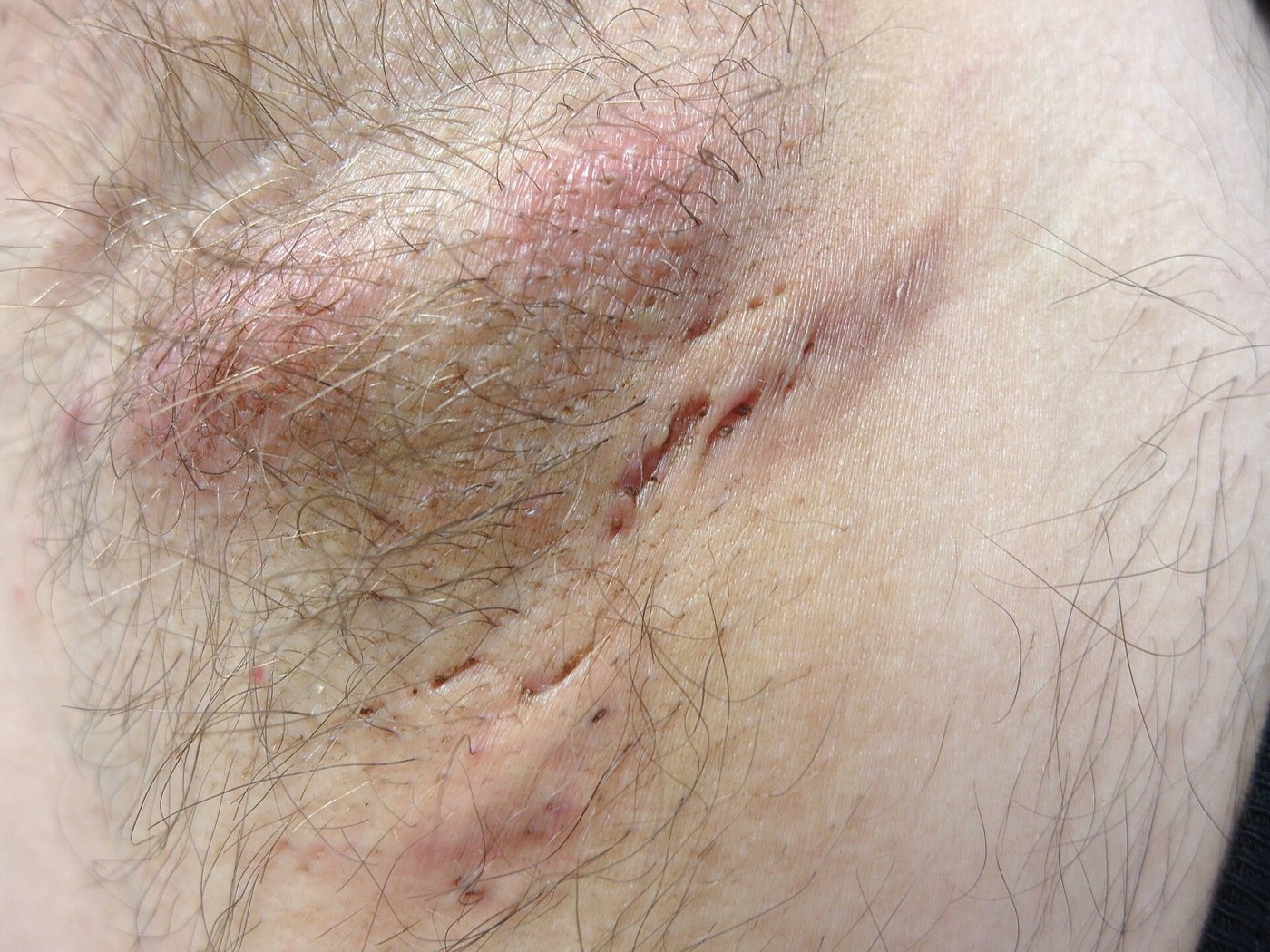
• Sites – inspect the axillae, groin/inguinal folds, perineal and perianal skin, inframammary folds, buttocks and genitals. |
|
• Active lesions – tender, erythematous nodules, fluctuant abscesses and purulent discharge. |
|
• Chronic changes – sinus tracts (tunnels), rope-like hypertrophic or atrophic scars, and double-ended “tombstone” comedones. |
|
• Severity – assign a Hurley stage at each affected site and record it in the referral letter, as it guides the pathway. |
|
• Associated signs – pilonidal sinus, severe nodulocystic acne or dissecting cellulitis (the follicular-occlusion tetrad). |
Source: British Association of Dermatologists · DermNet
💬 Patient Explanation
|
Hidradenitis suppurativa is a long-term skin condition that causes painful lumps, abscesses and scarring in areas like the armpits and groin. |
🧪 Investigations
| Test | Indication |
|---|---|
| Clinical diagnosis | • No confirmatory test exists – diagnose on typical lesions, typical sites and recurrence (two or more lesions in six months) • Do not delay treatment awaiting tests |
| Bacteriology swab | From a discharging lesion only if secondary infection is suspected or treatment is failing – guides antibiotic choice (lesions are often sterile). |
| Bloods – FBC, CRP | • In an acute flare, to assess systemic inflammation • At diagnosis and every year: check lipids and HbA1c • At the same reviews: ask about smoking and a family history of cardiovascular disease (CVD), and record body mass index (BMI) and blood pressure |
| Skin biopsy – Specialist-only | If there is diagnostic uncertainty or suspicion of squamous cell carcinoma (SCC) in a chronic lesion. |
| Impact assessment | Consider the DLQI (Dermatology Life Quality Index) and screen for depression – impact and mood are central to severity, not an afterthought. |
|
🧠 Clinical pearl • Hidradenitis suppurativa (HS) lesions are usually sterile: a swab grows nothing, or only skin commensals. • The long antibiotic courses used in HS work through their anti-inflammatory action, not by treating infection. • This is exactly why the courses run for 12 weeks rather than the 5–7 days you would prescribe for cellulitis. |
Source: British Association of Dermatologists · Primary Care Dermatology Society
💊 Management
| All patients |
|---|
|
1. Confirm the diagnosis clinically and assign a Hurley stage at each site to guide treatment and referral. |
|
2. Start treatment promptly in primary care; do not wait for the referral. |
|
3. Support lifestyle change: smoking cessation and weight loss, the two highest-impact measures. |
|
4. Provide pain control with regular simple analgesia: paracetamol ± a non-steroidal anti-inflammatory drug (NSAID). Pain is often the dominant symptom. |
|
5. Look beyond the skin: screen for metabolic syndrome, ask about bowel symptoms of inflammatory bowel disease (IBD), and offer mental-health support. |
|
🔑 Key principle – treat early, and treat the whole patient • Hidradenitis suppurativa (HS) is a progressive scarring disease, so the window to prevent irreversible tracts and scarring is early. • Start treatment as soon as you suspect it, even while a referral is being processed. • HS is linked with metabolic disease, IBD and a heavy burden of depression and anxiety. • Managing the skin alone misses most of the harm. |
Source: British Association of Dermatologists · NICE TA392 · TA935
🧾 Non-pharmacological Treatment
| Intervention | Details |
|---|---|
| Smoking cessation | • The most important modifiable factor • Offer behavioural support plus pharmacotherapy (e.g. nicotine replacement therapy, NRT) |
| Weight management | • Weight loss reduces friction, flares and metabolic risk • Refer to weight-management services where available • If obese, especially with related comorbidities, a glucagon-like peptide-1 (GLP-1) agonist can be considered (through weight-management services, in line with NICE) |
| Skin care & friction | • Prescribe an antiseptic wash for everyone, used as a soap substitute • Octenidine (Octenisan) is preferred over 4% chlorhexidine: it breaks down biofilms and may be gentler on the skin • Loose cotton clothing • Avoid shaving, waxing or depilatories in affected areas |
| Pain & wound care | • Simple analgesia and warm compresses • Absorbent dressings for discharging lesions (dedicated hidradenitis suppurativa [HS] dressing systems exist) |
| Psychological support | • Signpost the Hidradenitis Suppurativa Trust and Changing Faces • Advise self-referral to NHS Talking Therapies if mood is affected |
Source: British Association of Dermatologists · Primary Care Dermatology Society
⚕️ Pharmacological Treatment
| Treatment Options and Escalation |
|---|
|
➤ General principle |
|
→ Antibiotics are used for their anti-inflammatory effect (lesions are usually sterile), so courses are long (~12 weeks) with response reviewed at 12 weeks. Always check the current BNF and local formulary for doses and cautions. |
|
➤ Mild disease (Hurley I) – primary care |
|
→ Topical clindamycin 1% twice daily to active lesions, at first for 12 weeks. • Avoid alcohol-based preparations, as they sting. • Continue an antiseptic wash alongside. → Or an oral tetracycline, at first for 12 weeks: doxycycline 200 mg once daily, or lymecycline 408 mg, two capsules once daily (not in pregnancy, breastfeeding or under 12 years; in pregnancy use topical clindamycin). |
|
➤ Moderate disease (Hurley II) – primary care |
|
→ An oral tetracycline for at least 12 weeks: • doxycycline 200 mg once daily • lymecycline 408 mg, two capsules once daily • tetracycline 500 mg twice daily • Warnings: photosensitivity; avoid in pregnancy, breastfeeding and children under 12. • Take doxycycline with plenty of water sitting upright to avoid oesophagitis. |
|
→ If a tetracycline is unsuitable (e.g. pregnancy): erythromycin 500 mg twice daily (a macrolide) – in pregnancy, use in the 2nd/3rd trimester only after weighing risks. |
|
➤ Hormonal options (selected women) |
|
→ Consider, particularly with premenstrual flares or polycystic ovary syndrome (PCOS): • A combined oral contraceptive pill (COCP) with a favourable progestogen profile (for example one containing drospirenone, such as Yasmin or Eloine, or desogestrel, such as Mercilon). • These carry a higher venous thromboembolism (VTE) risk than levonorgestrel pills: check the UK Medical Eligibility Criteria for Contraceptive Use (UKMEC) first. • No pill is reliable contraception during rifampicin or for 28 days after stopping it (see Second line). • Spironolactone – risks hyperkalaemia and is avoided in pregnancy. • Metformin |
|
➤ Acute flare adjuncts |
|
→ Intralesional corticosteroid (triamcinolone) into individual inflamed lesions. Avoid corticosteroids if active infection is suspected. → If a very explosive flare suggests infection: avoid corticosteroids and give flucloxacillin 1 g four times a day for 10–14 days (clarithromycin 500 mg twice a day if allergic to flucloxacillin). |
|
➤ Second line – no or minimal response, or a rapid flare after stopping antibiotics |
|
→ The GP can start clindamycin 300 mg twice daily + rifampicin 300 mg twice daily for 12 weeks, and refer to dermatology at the same time. • Review at 12 weeks: if improving, continue clindamycin 300 mg twice daily for a further 12 weeks. • Key warning: rifampicin is a potent enzyme inducer and can make some hormonal contraception less effective. • Combined hormonal contraception (pill, patch or ring), the progestogen-only pill and the implant may be less effective during rifampicin and for 28 days after stopping it. • Offer a method that rifampicin does not affect: a copper intrauterine device, a levonorgestrel intrauterine system or the progestogen-only injection. • The 50 microgram ethinylestradiol combined pill sometimes used with other enzyme inducers is not an option with rifampicin. • Check urea and electrolytes (U&E) and liver function tests (LFTs) before starting; if normal, further checks are usually unnecessary, as liver damage is rare. • If liver damage happens, it is usually in the first 6 weeks: advise the patient to stop and seek urgent help with fever, malaise, vomiting or jaundice. • Check for other drug interactions before starting. • Warn the patient to stop clindamycin and seek help at once if diarrhoea develops (Clostridioides difficile). • Rifampicin turns urine and tears orange-red (it stains contact lenses). |
|
➤ Resistant disease – specialist-only |
|
→ Acitretin (an oral retinoid) or dapsone – specialist-only. • Acitretin is highly teratogenic (Pregnancy Prevention Programme). Avoid pregnancy for 3 years after stopping it, with a pregnancy test every 1–3 months during that time. • Dapsone can cause haemolysis (check G6PD, glucose-6-phosphate dehydrogenase) and agranulocytosis. |
|
➤ Biologics – specialist-only (moderate-to-severe hidradenitis suppurativa [HS] not responding to conventional systemic treatment) |
|
→ Adalimumab (Humira) – a tumour necrosis factor (TNF) inhibitor; the first-line licensed biologic (NICE TA392), response assessed at 12 weeks. Screen for latent tuberculosis (TB) and hepatitis B before starting. |
|
→ Secukinumab (Cosentyx) – an interleukin-17A inhibitor; an option where adalimumab is unsuitable, has failed or has stopped working (NICE TA935), response assessed at 16 weeks. |
|
➤ Surgery – specialist |
|
→ Incision & drainage (acute relief only), deroofing of sinus tracts, or wide local excision of chronically affected skin; laser hair removal in selected cases. |
Source: British Association of Dermatologists · NICE TA392 · TA935 · Primary Care Dermatology Society · College of Sexual and Reproductive Healthcare
📌 Special Notes
|
📌 Safety net – three things not to miss Sepsis • An acutely infected, fluctuant lesion with fever or systemic upset needs urgent admission. Cancer • Squamous cell carcinoma can rarely arise in long-standing, chronically inflamed disease (classically perianal/gluteal). • Any non-healing, indurated or rapidly changing lesion warrants a suspected cancer pathway referral (previously the two-week wait). Mood • Hidradenitis suppurativa (HS) carries a substantially raised risk of depression and suicide. • Ask about mood and safety-net actively. |
• No DVLA duty – hidradenitis suppurativa itself carries no notification requirement and does not restrict driving.
• Not infection, not hygiene – HS is a disorder of follicular occlusion; saying explicitly that it is not contagious and not caused by poor hygiene helps reduce shame and diagnostic delay.
• Comorbidity screen – actively look for and manage metabolic syndrome, type 2 diabetes, polycystic ovary syndrome (PCOS) and inflammatory bowel disease (IBD); refer for assessment if gut symptoms persist.
• Pregnancy – tetracyclines and retinoids are contraindicated; topical clindamycin (and, if needed, a macrolide in the 2nd/3rd trimester) are the safer options – seek specialist advice.
• Skin of colour – HS may be under-recognised and more severe in darker skin tones; post-inflammatory pigment change is common.
Source: British Association of Dermatologists
➡️ Referral Pathways
| Same-day/Urgent |
|---|
|
• Systemic sepsis → urgent admission |
|
• Acutely painful fluctuant abscess needing drainage → incision & drainage (I&D) for symptom relief in acute surgical/ambulatory care – this does not prevent recurrence |
| Suspected cancer pathway |
|---|
|
• Suspected squamous cell carcinoma (SCC) in a chronic lesion → skin-cancer pathway |
| Routine/Dermatology |
|---|
|
• Confirm diagnosis or Hurley II–III, treatment failure, or need for biologic/surgical consideration → dermatology via eRS (electronic Referral Service) • Severe Hurley III → immediate or urgent dermatology referral |
|
• Persistent bowel symptoms → gastroenterology for inflammatory bowel disease (IBD) assessment |
|
• Mood or quality of life affected → NHS Talking Therapies (self-referral) or mental-health services • Severe psychological impact → also refer to dermatology |
Source: British Association of Dermatologists · Primary Care Dermatology Society
🏠 Take Home Messages
• Diagnose clinically – typical lesions + typical flexural sites + chronicity (two or more lesions in six months); the hallmark sign is double-ended “tombstone” comedones.
• It is follicular occlusion, not infection or poor hygiene – swabs are usually sterile, so antibiotics are given for their anti-inflammatory effect, not to treat an infection.
• Lifestyle is core, and don’t delay – smoking cessation and weight loss reduce disease activity; start treatment as soon as hidradenitis suppurativa (HS) is suspected, even while referring.
• Use prolonged courses and escalate – topical clindamycin or an oral tetracycline (mild), an oral tetracycline (moderate), each for at least 12 weeks, then clindamycin + rifampicin (which the GP can start), then specialist treatment and biologics (adalimumab, or secukinumab if adalimumab fails).
• Look beyond the skin – screen for metabolic syndrome, inflammatory bowel disease (IBD) and polycystic ovary syndrome (PCOS), address the high burden of depression and suicide risk, and stay alert to rare squamous cell carcinoma (SCC) in long-standing lesions.
Source: British Association of Dermatologists · NICE TA392 · TA935 · Primary Care Dermatology Society
|
🧭 AKT – high-yield facts • HS is a disease of follicular occlusion in apocrine-bearing, intertriginous skin • Female:male 3:1 • Strongly linked to smoking and obesity • Diagnostic criteria: typical lesions + typical sites + recurrence (two or more lesions in six months) – a clinical diagnosis. • Hurley: → I (abscesses, no tracts/scars) → II (recurrent abscesses with tracts and scarring) → III (diffuse, interconnected tracts) • Ladder: → Mild → topical clindamycin 1% twice daily, or an oral tetracycline, for 12 weeks → Moderate → oral tetracycline ≥ 12 weeks → Second line → clindamycin + rifampicin (the GP can start) → Then adalimumab (TA392), and secukinumab (TA935) if adalimumab is unsuitable or fails • Antibiotics are used for their anti-inflammatory effect – swabs are typically sterile. • Classic trap: rifampicin induces liver enzymes and reduces combined oral contraceptive pill (COCP) efficacy; tetracyclines are contraindicated in pregnancy and under-12s. • Watch for SCC in long-standing perianal/gluteal disease and the raised risk of depression and suicide. |
|
🎯 SCA A 26-year-old woman attends having had recurrent painful lumps in the groin and armpits for six years. She has been seen many times for “boils”, treated with repeated short antibiotic courses and two incision & drainage procedures, and now has scarring and discharging tracts. She is a current smoker, finds the area embarrassing, has stopped swimming and dating, and quietly admits her mood has been very low. The challenge is recognising hidradenitis suppurativa after years of misdiagnosis and conveying that this is a lifelong condition. At the same time, the doctor needs to motivate smoking cessation without blame and sensitively explore her low mood and any risk. A strong consultation: • Explores her ideas, concerns and expectations (including the impact on relationships, work and self-image). • Explains the diagnosis honestly in clear chunks while explicitly reassuring her it is not caused by poor hygiene and not contagious. • Agrees a shared plan: starting topical/oral treatment now, referring to dermatology, and offering smoking-cessation and mental-health support. • Safety-nets for sepsis and for low mood. • Maintains empathy and respect for her autonomy throughout. |
📎Reference: Primary Care Dermatology Society. Hidradenitis suppurativa (syn. acne inversa). Available from: https://www.pcds.org.uk/clinical-guidance/hidradenitis-suppurativa
📎Reference: Ingram JR, Collier F, Brown D, et al. British Association of Dermatologists guidelines for the management of hidradenitis suppurativa (acne inversa) 2018. Br J Dermatol 2019;180(5):1009–1017. Available from: https://academic.oup.com/bjd/article/180/5/1009/6732702
📎Reference: NICE TA392. Adalimumab for treating moderate to severe hidradenitis suppurativa. Available from: https://www.nice.org.uk/guidance/ta392
📎Reference: NICE TA935. Secukinumab for treating moderate to severe hidradenitis suppurativa. Available from: https://www.nice.org.uk/guidance/ta935
📎Reference: DermNet. Hidradenitis suppurativa (acne inversa). Available from: https://dermnetnz.org/topics/hidradenitis-suppurativa
📎Reference: NHS. Hidradenitis suppurativa (HS). Available from: https://www.nhs.uk/conditions/hidradenitis-suppurativa/
📎Reference: College of Sexual and Reproductive Healthcare. Combined Hormonal Contraception (2019, amended 2023). Available from: https://www.cosrh.org/Common/Uploaded%20files/documents/fsrh-guideline-combined-hormonal-contraception-october-2023.pdf
📎Reference: College of Sexual and Reproductive Healthcare. Progestogen-only Pills (2022, amended 2023). Available from: https://www.cosrh.org/Common/Uploaded%20files/documents/fsrh-ceu-clinical-guideline-progestogen-only-pills-aug22-amended-11july-2023-.pdf
📎Reference: College of Sexual and Reproductive Healthcare. Progestogen-only Implant (2021, amended 2023). Available from: https://www.cosrh.org/Common/Uploaded%20files/documents/fsrh-guideline-progestogen-only-implants.pdf
Three whole topics are free to read. Every topic opens with a free account.
Your CPD is counted as you read, and kept from the day you join.
Join us, it’s free