 GPAtlas
🧭 When to suspect
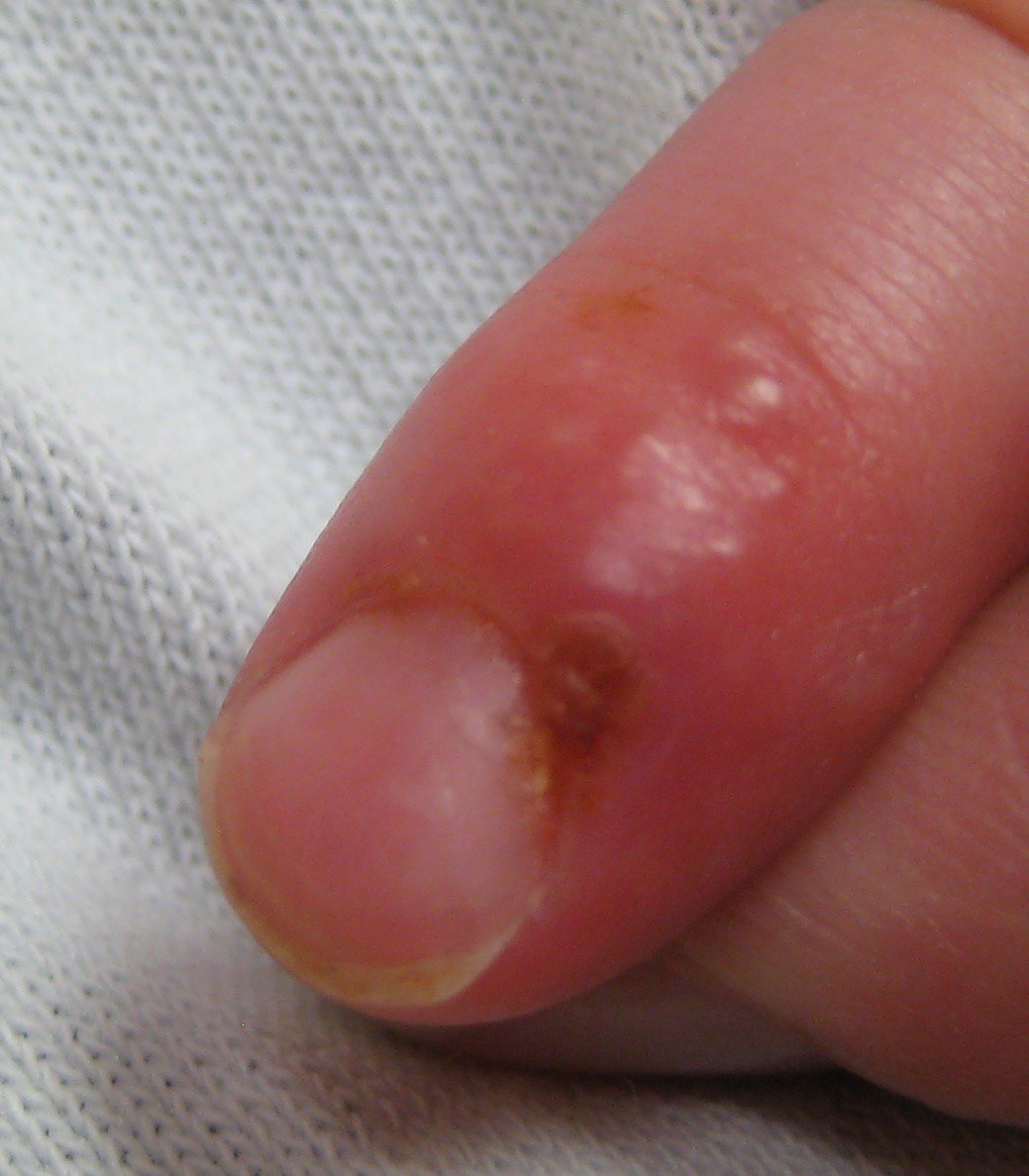
A herpetic whitlow is a painful infection of a finger or thumb (occasionally a toe) caused by the herpes simplex virus (HSV).
• HSV is the same virus that causes cold sores (HSV type 1) and genital herpes (HSV type 2).
• A whitlow usually affects the distal phalanx (fingertip), where the virus enters through a breach in the skin such as a torn cuticle.
Suspect it when a patient describes:
• A prodrome of tingling, burning or itching in the digit, followed within a day or two by painful, clustered, fluid-filled vesicles (small blisters) on a red base
• A personal or partner history of cold sores or genital herpes (common)
• Blister fluid that is typically clear rather than the frank pus of a bacterial infection
It follows a bimodal age pattern:
• Young children: autoinoculation from oral herpes, often through thumb-sucking
• Adults aged 20–30: genital herpes exposure, or occupational contact in healthcare and dental workers
It is uncommon – around 2.4 cases per 100,000 per year – which is precisely why it is so often misdiagnosed.
Distinguish it from a bacterial felon or paronychia, because the management is opposite: a herpetic whitlow is treated conservatively and must never be incised, whereas a bacterial pulp-space abscess needs drainage.
| Feature | Herpetic whitlow | Bacterial felon or paronychia |
|---|---|---|
| Cause | HSV-1 or HSV-2 | Usually Staphylococcus aureus |
| Prodrome | Tingling, burning or itch before the rash | None |
| Lesion | • Clustered clear vesicles on an erythematous base • May coalesce into bullae |
Tense erythema with a localised collection of frank pus |
| Fingertip pulp | Soft and non-tense | Tense, throbbing, often fluctuant |
| Fluid | Clear (may later turn turbid or sero-purulent) | Frank pus |
| Key action | Conservative ± oral antiviral – never incise | Incision and drainage ± antibiotic |
Source: DermNet
🩺 History
| Ask about symptoms |
|---|
|
• Are there painful blisters or vesicles on the finger or thumb? |
|
• Ask about a preceding tingling, burning or itching sensation (the viral prodrome)? |
|
• Confirm whether the blister fluid is clear (suggesting viral) or cloudy/purulent (suggesting bacterial superinfection)? |
|
• Ask about systemic symptoms – fever or malaise (common in a first, primary infection)? |
|
• Ask whether the blistering has spread proximally up the finger or hand, or whether there is red streaking (lymphangitis)? |
| Ask about risk factors and modifiers |
|---|
|
• Check for a personal history of cold sores (HSV-1) or genital herpes (HSV-2)? |
|
• Ask about contact with active herpes lesions in themselves or others? |
|
• Explore occupation (healthcare, dentistry) or habits such as thumb-sucking in children? |
|
• Check for immunocompromise – HIV, chemotherapy, diabetes or immunosuppressant drugs? |
|
• Ask about recent trauma to the digit (e.g. a torn cuticle) and any previous similar episodes (recurrence)? |
| 🧩 Patient Perspective |
|---|
|
➤ "Explore the patient's understanding of the contagious nature of the virus and the importance of hygiene and not touching the eyes?" |
|
➤ "Ask how the infection affects work – especially patient contact or food handling – and whether they wear contact lenses?" |
Source: DermNet
⚠️ Red Flags
| Escalation criteria |
|---|
|
➤ Suspected bacterial superinfection → any one of: • Rapidly spreading redness • Frank pus • Systemic upset → reassess and add an antibiotic |
|
➤ Proximal spread or lymphangitis: • Vesicles coalescing into bullae • Red streaking up the limb • Tender epitrochlear or axillary nodes → urgent assessment |
|
➤ Ocular symptoms: • Eye pain • Redness • Watering → risk of herpetic keratitis, especially in contact-lens wearers → same-day ophthalmology |
|
➤ Immunocompromised host → risk of severe, extensive or necrotic infection → specialist advice and systemic antiviral |
|
➤ Recurrent or non-healing lesions → reconsider the diagnosis and consider HIV testing |
|
➤ Tense, throbbing, fluctuant fingertip → consider a bacterial felon needing drainage rather than a whitlow |
Source: DermNet
🔎 Examination
| Examination findings and signs |
|---|
|
• Inspect for grouped vesicles on an erythematous base over the distal phalanx (may look honeycomb-like); the fluid is usually clear, sometimes turbid. |
|
• Palpate the pulp – typically soft and non-tense in a whitlow; a tense, fluctuant pulp instead suggests a bacterial felon. |
|
• Confirm there is no fluctuance – this is not a drainable abscess. |
|
• Check regional lymph nodes – tender epitrochlear (inner elbow) and axillary nodes are common in primary infection. |
|
• Look for proximal spread – red tracking (lymphangitis) or vesicles coalescing into larger bullae. |
|
• Examine or ask about the eyes if the patient wears contact lenses or may have touched the eye. |
|
⚠️ Common pitfall • The classic error is treating a herpetic whitlow as a pyogenic abscess and incising it. • Because the lesion is viral, drainage releases no pus, does not help, and can drive viraemia, secondary bacterial infection and delayed healing. • The clues are a tingling/burning prodrome, clustered clear vesicles and a soft, non-tense pulp. • If you are genuinely unsure, take a herpes simplex virus (HSV) swab and review – do not incise it. |
Source: DermNet
💬 Patient Explanation
|
A herpetic whitlow is a finger infection caused by the cold-sore virus – it is a viral blister, not a boil. |
🧪 Investigations
| Test | Indication |
|---|---|
| Clinical diagnosis | • First-line in most cases – the prodrome plus clustered vesicles on a red base is usually enough • No test is needed |
| Viral swab for herpes simplex virus (HSV) PCR (polymerase chain reaction) | If the diagnosis is uncertain, the patient is immunocompromised, or the lesion is recurrent or not resolving. |
| Bacterial swab (microscopy, culture & sensitivity, MC&S) | Only if a secondary bacterial infection is suspected (frank pus, spreading erythema). |
| HIV test | Offer if lesions are unusually extensive, severe or recurrent – a whitlow can be the first clue to immunosuppression. |
|
🧠 Clinical pearl • Herpetic whitlow is a clinical diagnosis: a swab is rarely needed. • HSV establishes lifelong latency in the sensory ganglion, so recurrences are common and usually milder than the first episode. • An unusually severe, extensive or recurrent whitlow should prompt you to consider undiagnosed immunosuppression, including HIV. |
Source: DermNet
💊 Management
| All patients |
|---|
|
1. Make the diagnosis clinically and reassure – it is self-limiting and usually heals in 2–3 weeks. |
|
2. Do NOT incise or drain: it is contraindicated. |
|
3. Cover the lesion with a clean, dry dressing to reduce transmission, and give simple analgesia. |
|
4. Consider an oral antiviral if presenting within 48 hours of onset (most benefit in primary or severe disease). |
|
5. Advise on hygiene and on protecting the eyes. |
| If severe/urgent |
|---|
|
• Confirmed bacterial superinfection → add an antibiotic (do not stop the antiviral). |
|
🔑 Key principle – it is self-limiting; recognition is the treatment • Most herpetic whitlows need only reassurance, analgesia and good hygiene and heal in 2–3 weeks. • An oral antiviral shortens the episode only modestly, and mainly when started within 48 hours. • Do not escalate care simply to obtain an antiviral. • The real value you add is making the correct diagnosis and avoiding harmful interventions. |
Source: DermNet
🧾 Non-pharmacological Treatment
| Intervention | Details |
|---|---|
| Keep it covered | A clean, dry dressing over the lesion until healed – reduces spread to other sites and to other people. |
| Hand hygiene | • Wash hands carefully • Healthcare staff and carers should wear gloves when in contact with the lesion |
| Protect the eyes | Avoid touching the eyes and do not wear contact lenses until healed – prevents herpetic keratitis. |
| Discourage thumb-sucking | In children, to prevent oral autoinoculation and to avoid prolonging the infection. |
| Avoid sharing/contact | • Do not share towels • Avoid direct skin contact (e.g. contact sports) while lesions are active |
| Work considerations | Healthcare, dental and food-handling staff may need to cover the lesion or avoid direct contact until healed – follow occupational-health and local policy. |
Source: DermNet
⚕️ Pharmacological Treatment
| Treatment Options and Escalation |
|---|
|
➤ Antiviral therapy – most useful when started within 48 hours of onset |
|
→ Aciclovir (Zovirax) – 200 mg five times daily, or 400 mg three times daily, for 5 days; first-line in the UK. Maintain good hydration and use with caution and dose reduction in renal impairment. |
|
→ In immunocompromised patients the dose is typically doubled (e.g. aciclovir 400 mg five times daily) and continued longer – usually a specialist decision. |
|
→ Valaciclovir (Valtrex) – the prodrug of aciclovir; an alternative with less frequent dosing, where preferred or per local formulary. |
|
→ Suppressive antiviral therapy – specialist-initiated for frequent, troublesome recurrences. |
|
➤ Symptom relief (all patients) |
|
→ Paracetamol, a non-steroidal anti-inflammatory drug (NSAID, e.g. ibuprofen), or both, for pain. |
|
➤ Bacterial superinfection only |
|
→ Flucloxacillin first-line for secondary staphylococcal infection; clarithromycin or erythromycin if penicillin-allergic. Antibiotics are not indicated for an uncomplicated herpetic whitlow. |
Source: DermNet
📌 Special Notes
|
📌 Safety – do not incise, and protect the eyes • A herpetic whitlow is not an abscess: incision or drainage is contraindicated and risks viraemia, secondary bacterial infection and delayed healing. • Autoinoculation to the eye can cause herpetic keratitis (a sight-threatening infection) – advise patients not to touch their eyes and to avoid contact lenses until healed. |
• Recurrence – because herpes simplex virus (HSV) lies dormant in the sensory ganglion, whitlows can recur; recurrent episodes are usually milder and shorter than the first.
• Viral shedding – the lesion remains infectious until fully healed (crusted over); keep it covered and maintain hygiene throughout.
• Occupational risk – historically common in dental and healthcare staff before universal glove use; cover lesions and follow occupational-health guidance for patient- or food-facing roles.
• Other mimics – besides a felon and paronychia, a whitlow can rarely be mistaken for flexor tenosynovitis (a surgical emergency). Reconsider the diagnosis if there is severe pain on passive finger extension or a uniformly swollen, sausage-shaped finger.
Source: DermNet
➡️ Referral Pathways
| Same-day/urgent |
|---|
|
• Ocular involvement (eye pain, redness, watering) → same-day ophthalmology (risk of herpetic keratitis) |
|
• Immunocompromised, or severe, extensive or necrotic lesions → urgent specialist advice (infectious diseases or dermatology) ± admission, and a systemic antiviral |
|
• Spreading bacterial superinfection with systemic features → acute assessment |
|
• Tense, fluctuant pulp suggesting a bacterial felon (diagnostic doubt) → hand or surgical assessment for possible drainage |
| Routine or primary care |
|---|
|
• Most uncomplicated cases → manage in primary care with analgesia, hygiene advice and safety-netting |
|
• Diagnosis uncertain or not resolving → GP follow-up; consider a herpes simplex virus (HSV) swab |
|
• Frequent recurrences → consider referral for suppressive antiviral therapy |
Source: DermNet
🏠 Take Home Messages
• Diagnose clinically – a tingling/burning prodrome followed by clustered clear vesicles on a red fingertip, often with a history of cold sores or genital herpes.
• Never incise it – a herpetic whitlow is viral, not a pyogenic abscess; incision risks viraemia, bacterial superinfection and delayed healing.
• Distinguish from a bacterial felon – the whitlow pulp is soft and non-tense; a felon is tense, throbbing and fluctuant and needs drainage.
• Consider aciclovir early – if seen within 48 hours of onset (200 mg five times daily for 5 days), with most benefit in primary or severe disease; otherwise reassure, as it self-resolves in 2–3 weeks.
• Contain and protect – keep the lesion covered, maintain hand hygiene, avoid touching the eyes and contact lenses, and consider HIV testing if the whitlow is unusually severe or recurrent.
Source: DermNet
|
🧭 AKT – high-yield facts • Cause: HSV-1 or HSV-2 → In children usually HSV-1 via autoinoculation from oral herpes (thumb-sucking) → In adults, genital herpes or occupational exposure (dental or healthcare staff) • Classic presentation: prodromal tingling/burning, then clustered clear vesicles on an erythematous distal phalanx; the fluid is clear, not pus. • The key exam point: incision and drainage is contraindicated – herpetic whitlow is managed conservatively; a bacterial felon (tense, fluctuant) is the one that needs drainage. • Treatment: aciclovir 200 mg five times daily for 5 days if started within 48 hours; otherwise self-limiting over 2–3 weeks. • Complications: secondary bacterial infection, herpetic keratitis (avoid contact lenses), and recurrence due to ganglionic latency. • Think HIV/immunosuppression if the whitlow is extensive, severe, necrotic or recurrent. |
|
🎯 SCA A 34-year-old healthcare assistant attends with a painful, blistered index finger that began three days ago with "pins and needles". An out-of-hours clinician started flucloxacillin 48 hours ago, but it is no better and she is asking whether the finger should be "lanced to let it drain". She is anxious about being off work and about her young child at home. The challenge is that this is most likely a herpetic whitlow (viral), so the requested incision is contraindicated and the antibiotic is probably unnecessary. Yet the patient expects drainage and reassurance, and you must correct the earlier management sensitively without undermining a colleague. A strong consultation: • Explores her ideas, concerns and expectations (ICE) – her belief that it is a boil, and her worry about work and passing it to her child. • Explains in plain language that this is a viral blister, not pus, so it must not be cut and usually heals itself in a couple of weeks. • Agrees a shared plan: explain that aciclovir helps little now she is past 48 hours; simple analgesia, keep it covered, careful hand hygiene, and avoid touching the eyes and contact lenses. • Agrees a brief discussion with occupational health about patient-facing duties. • Safety-nets clearly about spreading redness, eye symptoms or systemic upset. • Shows empathy and respects her autonomy throughout. |
📎Reference: NICE CKS. Whitlow (staphylococcal and herpetic). Available from: https://cks.nice.org.uk/topics/whitlow-staphylococcal-and-herpetic/
📎Reference: DermNet. Herpetic whitlow. Available from: https://dermnetnz.org/topics/herpetic-whitlow
📎Reference: electronic Medicines Compendium (emc). Aciclovir 200mg Tablets: Summary of Product Characteristics. Available from: https://www.medicines.org.uk/emc/product/2353/smpc
📎Reference: NHS. Herpetic whitlow (whitlow finger). Available from: https://www.nhs.uk/conditions/herpetic-whitlow/
📎Reference: Amin N, Darcey J. Primary gingivostomatitis and herpetic whitlow. Br Dent J 2023;234:510. Available from: https://www.nature.com/articles/s41415-023-5744-6
Three whole topics are free to read. Every topic opens with a free account.
Your CPD is counted as you read, and kept from the day you join.
Join us, it’s free