 GPAtlas
🧭 When to suspect
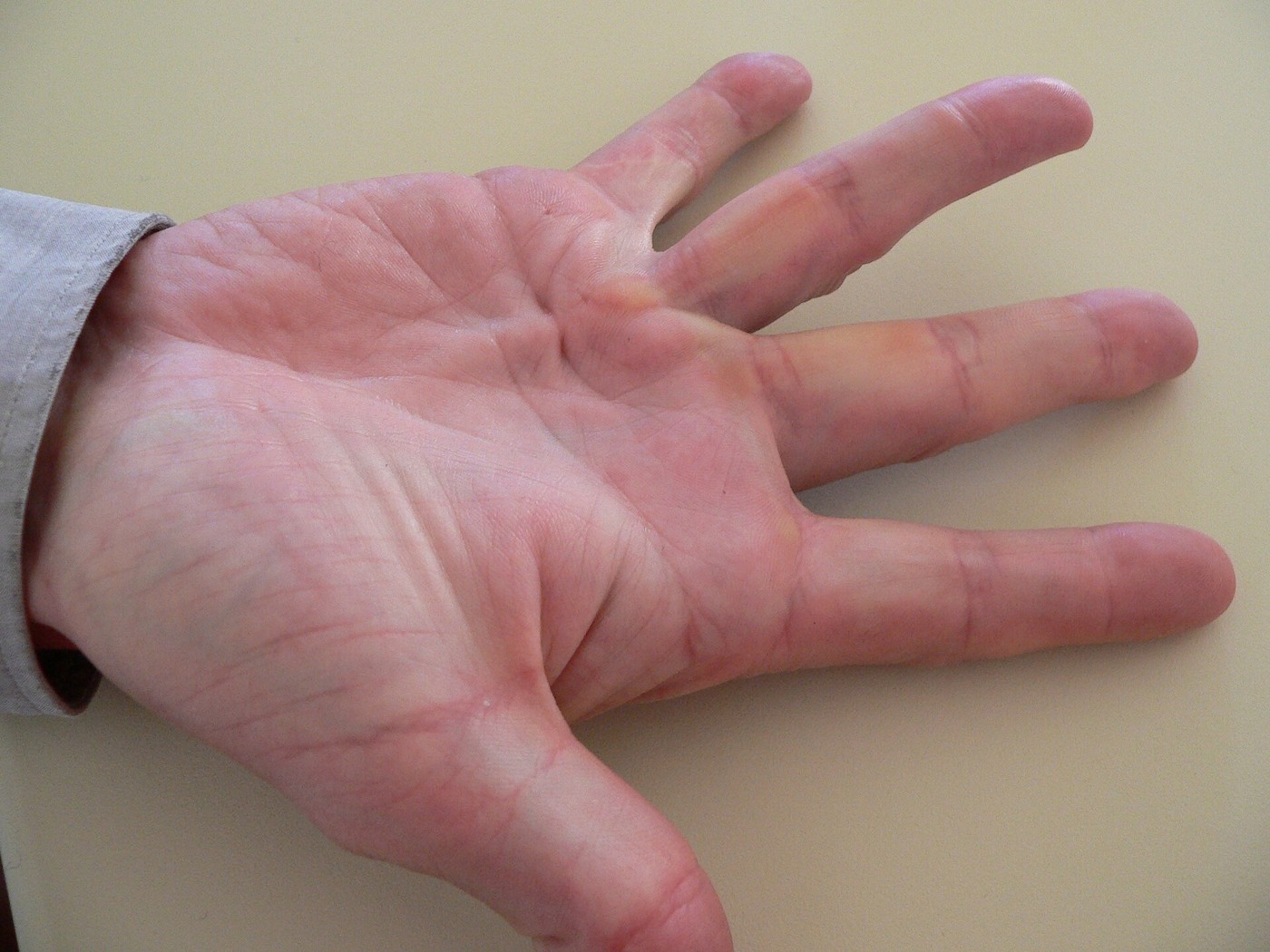
Dupuytren's disease is a benign, slowly progressive fibroproliferative disorder of the palmar and digital fascia. Thickened tissue forms nodules and then cords that can draw one or more fingers into fixed flexion – most often the ring and little fingers.
It is common:
• Affecting around 4% of the UK population and a much higher proportion of older men
• Strongly associated with Northern European ancestry
• Up to six times more common in men than women
Most disease is painless and never needs intervention – only about one in three affected people progress to a cord and contracture.
In the surgery:
• Recognise it clinically
• Decide who needs referral, driven by contracture and hand function, not by the mere presence of a nodule
• Do not mislabel an atypical hand lump as Dupuytren's
Suspect Dupuytren's when there is:
• Thickening, pitting or puckering of the palmar skin
• A firm palmar nodule
• A cord with early bending of a finger
Raise your index of suspicion with:
• A family history
• Increasing age
• Smoking
• Excess alcohol
• Diabetes
| Clinical picture | Primary-care action |
|---|---|
| Palmar nodule(s) only, no contracture | • Reassure, observe and safety-net • Tender nodules usually settle with time |
| Cord with mild contracture, hand still lies flat, function preserved | • Observe and address risk factors • Refer if progressing or affecting function |
| Cannot lay the palm flat (positive Hueston tabletop test), or metacarpophalangeal (MCP) over 30° or proximal interphalangeal (PIP) over 15° | Refer to hand surgery. |
| Significant functional impairment (any angle) | Refer to hand surgery. |
🩺 History
| Ask about symptoms |
|---|
|
• Establish any thickening, pitting or puckering of the palmar skin? |
|
• Confirm firm lumps (nodules) or thick bands (cords) in the palm? |
|
• Ask whether a finger (especially the ring or little) is bending towards the palm, and over what timescale? |
|
• Determine whether the hand can be laid completely flat on a table (the tabletop test)? |
|
• Ask about pain (usually painless, though early nodules can be tender) and any catching when reaching into a pocket? |
|
• Clarify the functional impact – washing the face, wearing gloves, gripping, shaking hands? |
| Ask about risk factors and modifiers |
|---|
|
• Note age and family origin – prevalence is highest in those of Northern European descent? |
|
• Explore family history of Dupuytren's or a related condition – the disease is strongly heritable? |
|
• Check smoking status (around 3× risk) and alcohol intake? |
|
• Ask about diabetes (often a milder form) and anticonvulsant use (the risk historically attributed to "epilepsy")? |
|
• Screen for ectopic disease – lumps on the soles (Ledderhose) or penile curvature (Peyronie's) – suggesting an aggressive diathesis? |
|
• Note occupation – heavy manual work or prolonged vibrating-tool use (association debated) – and any previous hand trauma? |
| 🧩 Patient Perspective |
|---|
|
➤ "Ask how the condition affects everyday tasks – washing the face, putting a hand in a pocket, wearing gloves, gripping tools or shaking hands?" |
|
➤ "Explore the patient's ideas and concerns – many fear it is arthritis or cancer, or worry about losing the use of the hand – and what they hope any treatment would achieve?" |
⚠️ Red Flags
| Escalation criteria |
|---|
|
➤ Atypical hand lump → any one of: • Rapidly growing • Painful • Soft or cystic • Dorsal • Not a typical palmar cord → consider an alternative diagnosis → urgent assessment to exclude soft-tissue sarcoma rather than labelling as Dupuytren's |
|
➤ Rapidly progressing or new proximal interphalangeal (PIP) joint contracture → deformity can become irreversible → prompt hand-surgery referral |
|
➤ Aggressive Dupuytren's diathesis: • Onset under 50 • Bilateral disease • Strong family history • Ectopic disease → flag for earlier specialist review |
|
➤ Positive Hueston tabletop test (cannot place the palm flat) → significant contracture → refer to hand surgery |
|
➤ Significant functional impairment from contracture → refer to hand surgery |
Source: BSSH
🔎 Examination
| Examination findings and signs |
|---|
|
• Inspection – palmar skin pitting, dimpling or puckering; identify nodules and cords, and note which digits are affected. |
|
• Palpation – firm nodules and longitudinal cords in the palm and fingers; usually non-tender. |
|
• Contracture – assess fixed flexion at the metacarpophalangeal (MCP) and proximal interphalangeal (PIP) joints; record the affected digit and approximate angle. |
|
• Hueston tabletop test – ask the patient to lay the palm flat on a table; a positive test (the hand will not lie flat) indicates a significant contracture and warrants referral. |
|
• Garrod's pads – knuckle pads over the dorsal PIP joints (a marker of diathesis). |
|
• Look further if diathesis is suspected – check for plantar nodules (Ledderhose) and ask about Peyronie's disease. |
|
🧠 Clinical pearl • The Dupuytren's diathesis predicts trouble. ➤ Features that point to aggressive, recurrence-prone disease: • Bilateral disease • Onset before 50 • A strong family history • Involvement of the radial-side (thumb/index) digits • Ectopic disease (Ledderhose plantar nodules, Peyronie's, Garrod's knuckle pads) • Spotting these features should lower your threshold for referral and prepare the patient for a higher chance of recurrence after treatment. |
💬 Patient Explanation
|
Dupuytren's is a slow thickening of the tissue just under the skin of your palm, which can form firm lumps and cords. |
🧪 Investigations
| Test | Indication |
|---|---|
| Clinical diagnosis | • Dupuytren's is diagnosed on history and examination alone • No imaging or blood tests are needed to confirm it |
| HbA1c, LFTs, lipids | Consider only if the history suggests undiagnosed diabetes, harmful alcohol use or hyperlipidaemia – not as routine screening. |
| Imaging (ultrasound/MRI) – Specialist-initiated | • Not required for typical disease • Reserved by specialists for atypical lumps to exclude an alternative soft-tissue diagnosis |
💊 Management
| All patients |
|---|
|
1. Confirm the diagnosis clinically and assess contracture and hand function. |
|
2. Reassure, observe and safety-net for nodules or mild disease with the hand still flat and function preserved. |
|
3. Ask them to return if a finger starts to bend or the hand no longer lies flat on a table. |
|
4. Optimise general health, including good diabetes control. |
|
5. Refer to hand surgery before the contracture becomes severe: usually a metacarpophalangeal (MCP) contracture over 30°, a proximal interphalangeal (PIP) contracture over 15°, a positive tabletop test, or significant functional impairment. |
| If severe/urgent |
|---|
|
• Rapidly progressing or new proximal interphalangeal (PIP) contracture → refer promptly; established PIP deformity may not fully correct even with surgery. |
|
• Definitive treatment is procedural and specialist-led – needle fasciotomy or fasciectomy – not a primary-care prescription. |
|
• Atypical or rapidly enlarging lump → refer to exclude an alternative diagnosis rather than reassure. |
|
🔑 Key principle – treat function, not the lump • Dupuytren's is benign, and the presence of a nodule is not in itself a reason to refer or treat. • The decision is driven by contracture and hand function – a positive tabletop test, a metacarpophalangeal (MCP) contracture over 30°, or a PIP contracture over 15°. • The one trap is delay: once a PIP joint contracture becomes fixed, full correction may be impossible, so refer promptly once a finger genuinely starts to bend. |
🧾 Non-pharmacological Treatment
| Intervention | Details |
|---|---|
| Observation ('watch and wait') | • The default for nodules or mild disease with preserved function • Many cases progress very slowly or not at all |
| Education and reassurance | Explain the benign nature, the slow course, and that tender nodules usually settle. |
| Risk-factor advice | • Smoking cessation and reducing excess alcohol for general health • Evidence that this alters the Dupuytren's course is limited |
| Radiotherapy | • Sometimes offered for early progressive disease (nodules/cords before significant contracture) to try to slow it – but NICE judged the evidence inadequate for routine use • Specialist-only, offered only under special clinical-governance or research arrangements, so availability is very limited |
| Hand therapy or splinting after surgery | A post-operative, specialist-directed measure – not a primary-care treatment for the disease itself. |
|
⚠️ Common pitfall • Prescribing splints, stretches or massage to "hold back" a contracture. • There is no evidence that splinting, stretching or massage prevents progression or corrects an established deformity. • Advising them wastes time and can falsely reassure. • If a finger is bending and affecting function, the answer is referral, not a splint. |
Source: NICE HTG427 · BSSH
⚕️ Pharmacological Treatment
| Treatment Options and Escalation |
|---|
|
➤ The key message – there is no disease-modifying drug |
|
→ No medication shrinks a cord, reverses a contracture, or reliably halts progression. Dupuytren's is fundamentally a surgical condition; drug treatment has only a small, symptomatic role. |
|
➤ Intralesional corticosteroid – for painful nodules only |
|
→ An injection of corticosteroid (e.g. triamcinolone acetonide) may ease an intolerably painful nodule, but it does not correct a contracture. • Reserve it for genuine nodule pain (most settle without treatment). • Warn about local side-effects – skin and subcutaneous fat atrophy, depigmentation, and a post-injection flare. |
|
➤ Collagenase clostridium histolyticum (Xiapex) – no longer available in the UK |
|
→ This enzyme injection dissolved the cord and was once a non-surgical option. • It was withdrawn from the UK and European market in March 2020 for commercial reasons (not safety or efficacy), and NICE technology appraisal TA459 has been withdrawn. • It should no longer be offered or promised to patients. |
|
➤ Definitive treatment (specialist-only) – procedural, not pharmacological |
|
→ Needle fasciotomy (percutaneous division of the cord under local anaesthetic; suited to metacarpophalangeal [MCP] contractures and less-fit patients), or fasciectomy (limited/regional removal of diseased fascia; dermofasciectomy with skin graft for skin involvement, recurrence, or younger patients with diathesis). Recurrence is common after any procedure. |
📌 Special Notes
|
📌 Practice & prescribing note • Collagenase (Xiapex) is no longer available in the UK: do not offer or promise it. • The definitive options are needle fasciotomy and fasciectomy. • There is no DVLA notification duty – Dupuytren's is not a notifiable condition. • Fitness to drive only becomes a consideration in the rare case of severe bilateral contractures that prevent safe control of the vehicle. • After surgery, patients typically resume driving once the wound has healed and they can hold and turn a wheel safely (often around two weeks). |
• Refer on function and contracture, not on nodules – isolated palmar nodules without contracture do not need referral or intervention, and most tender nodules settle.
• Local commissioning thresholds vary – many policies use loss of extension of ≥ 30° at the metacarpophalangeal (MCP) or ≥ 20° at the proximal interphalangeal (PIP) joint, plus a positive tabletop test or functional impairment. Treatment is generally not commissioned for purely cosmetic reasons or mild, non-progressive disease.
• The vibration or manual-work link is contested – bodies such as British Society for Surgery of the Hand (BSSH) and the NHS state there is no clear association with manual work, whereas occupational-injury schemes recognise prolonged hand-transmitted vibration; family history and Northern European ancestry are the dominant risks.
• Expect recurrence – no treatment cures the disease; warn patients that contracture can recur after any procedure and that pre-morbid hand function may not be fully regained.
• Do not watch a bending finger indefinitely – the slowly progressive course is reassuring, but once a PIP contracture develops, timely referral matters because the deformity can become irreversible.
➡️ Referral Pathways
| Prompt referral |
|---|
|
• Atypical or rapidly enlarging lump → urgent assessment to exclude soft-tissue sarcoma |
|
• Rapidly progressing or new proximal interphalangeal (PIP) contracture → hand surgery promptly (risk of irreversible deformity) |
| Routine (hand surgery) |
|---|
|
• Metacarpophalangeal (MCP) contracture over 30° or PIP contracture over 15° → hand surgery |
|
• Positive tabletop test or significant functional impairment → hand surgery |
| Manage in primary care |
|---|
|
• Palmar nodule(s) without contracture → reassure, observe, safety-net |
|
• Mild contracture, hand still lies flat, function preserved → observe; refer if progressing |
🏠 Take Home Messages
• Diagnose clinically – the classic picture is palmar pitting/puckering, firm nodules and cords causing fixed flexion of the ring and little fingers; no imaging or bloods are needed.
• Use the Hueston tabletop test – if the patient cannot lay the palm flat, the contracture is significant and warrants referral.
• Watch and wait for mild disease – reassure patients with nodules or minor, non-progressive contracture that no treatment is needed, and that tender nodules settle with time.
• Refer on contracture and function – to hand surgery before the contracture becomes severe: a metacarpophalangeal (MCP) contracture over 30°, a proximal interphalangeal (PIP) contracture over 15°, a positive tabletop test, or significant functional impairment. Do not delay once a PIP contracture develops, as it can become irreversible.
• There is no disease-modifying drug – splinting and stretching do not work, collagenase (Xiapex) is no longer available in the UK, and the definitive treatment is surgical (needle fasciotomy or fasciectomy), with recurrence common.
|
🧭 AKT – high-yield facts • Classic triad: palmar skin pitting/puckering, firm nodules, and cords → fixed flexion deformity, usually of the ring and little fingers; the ring finger is typically affected first and disease is often bilateral. • Risk factors: Northern European ancestry, family history (strongly heritable), male sex (up to 6×), increasing age, smoking (~3×), excess alcohol, diabetes (often milder disease), and anticonvulsant use (the risk historically attributed to "epilepsy"). • Dupuytren's diathesis = bilateral disease + onset under 50 + strong family history + ectopic disease (Ledderhose plantar fibromatosis, Peyronie's, Garrod's knuckle pads) + radial involvement → aggressive, recurrence-prone disease. • Diagnosis is clinical – no routine imaging or blood tests; the Hueston tabletop test is the practical screen for a significant contracture. • Referral triggers: MCP contracture over 30°, PIP contracture over 15°, a positive tabletop test, or functional impairment. • Treatment: needle fasciotomy or fasciectomy (dermofasciectomy for skin involvement/diathesis); recurrence common. Collagenase (Xiapex) was withdrawn from the UK in 2020. Steroid injection helps only painful nodules, not contracture. Splinting/stretching is ineffective. NICE found the evidence for radiotherapy inadequate for routine use. |
|
🎯 SCA A 58-year-old self-employed plumber attends because his ring and little fingers on the right hand have increasingly curled into his palm over the past few months. He can no longer lay the hand flat and is struggling to grip tools and put the hand into his pocket. He has read online about an injection ("the enzyme one") that avoids surgery and asks for it, because he is worried that an operation will keep him off work and out of pocket. The challenge is that the treatment he wants – collagenase (Xiapex) – is no longer available in the UK, his contracture now genuinely warrants referral, and any procedure carries downtime and a real risk of recurrence, against a background of self-employment with no sick pay. A strong consultation: • Explores his ideas, concerns and expectations – particularly the impact on his work, income and ability to keep gripping tools. • Explains honestly and kindly that the enzyme injection has been withdrawn in the UK, without dismissing his research. • Sets out the realistic options (needle fasciotomy, with a shorter recovery, versus fasciectomy) and that recurrence is possible, in clear chunks. • Agrees a shared plan including referral to hand surgery and signposting to practical and financial support. • Safety-nets – to return promptly if the contracture worsens or the hand becomes harder to use. • Respects his autonomy over whether and when to proceed. |
📎Reference: NICE CKS. Dupuytren's disease. Available from: https://cks.nice.org.uk/topics/dupuytrens-disease/
📎Reference: British Society for Surgery of the Hand (BSSH). Dupuytren's disease (patient information). Available from: https://www.bssh.ac.uk/patients/conditions/25/dupuytrens_disease
📎Reference: NICE HealthTech guidance HTG427. Radiation therapy for early Dupuytren's disease. Available from: https://www.nice.org.uk/guidance/htg427
📎Reference: NHS. Dupuytren's contracture. Available from: https://www.nhs.uk/conditions/dupuytrens-contracture/
📎Reference: Dupuytren's contracture – current concepts. J Clin Orthop Trauma 2020. Available from: https://pmc.ncbi.nlm.nih.gov/articles/PMC7355095/
Three whole topics are free to read. Every topic opens with a free account.
Your CPD is counted as you read, and kept from the day you join.
Join us, it’s free