 GPAtlas
🧭 When to suspect
A boil (furuncle) is a deep bacterial infection of a single hair follicle that forms a small abscess. A carbuncle is a deeper, interconnected cluster of infected follicles draining through several points.
Both sit on a spectrum with simple folliculitis and are usually caused by Staphylococcus aureus.
• Suspect a boil when there is a painful, firm, red nodule in a hair-bearing, friction-prone area (neck, axilla, buttock, thigh) that enlarges over days and becomes fluctuant.
• Suspect a carbuncle when the lesion is larger, indurated and discharging from multiple sinuses, often with systemic upset.
The two clinical priorities in primary care are:
• To recognise when drainage rather than an antibiotic is the answer.
• To identify the minority who need escalation – the systemically unwell, the immunocompromised, the central-face lesion, and the patient with recurrent or clustered boils suggesting PVL-producing S. aureus (PVL: Panton-Valentine Leukocidin).
| Lesion | What it is | Typical features |
|---|---|---|
| Folliculitis | Superficial inflammation or infection of a hair follicle | • Small papules and pustules, often pierced by a central hair • Usually mild and self-limiting |
| Furuncle (boil) | A deeper follicular infection forming a small abscess | • Firm, tender, red nodule that enlarges, becomes fluctuant and points • Discharges pus and a necrotic core |
| Carbuncle | Coalescence of several adjacent infected follicles | • Larger, deeper, indurated mass (classically nape of neck or back) with multiple draining sinuses • Systemic upset more likely |
Risk is higher with:
• Diabetes, obesity or iron-deficiency anaemia.
• Immunosuppression (illness or drugs such as corticosteroids).
• Atopic eczema or other skin disease.
• Smoking.
• Nasal or perineal staphylococcal carriage.
Transmission is favoured by skin-to-skin contact, shared towels or razors, and close communities such as households and contact-sports teams.
Source: DermNet
🩺 History
| Ask about symptoms |
|---|
|
• Establish the duration and progression of the lesion(s), and whether it is single or multiple? |
|
• Confirm whether it is painful or tender, and whether it has begun to point or discharge pus? |
|
• Ask about systemic symptoms – fever, rigors, malaise or feeling generally unwell? |
|
• Check for spreading redness, swelling or pain around the lesion (possible cellulitis)? |
|
• Ask about recurrent episodes or recurring crops of boils over time? |
|
• Note the site – particularly any lesion on the central face (nose, upper lip, cheek)? |
| Ask about risk factors and modifiers |
|---|
|
• Check for diabetes, obesity, or iron-deficiency anaemia? |
|
• Ask about chronic skin disease (e.g. atopic eczema) and any immunosuppression – illness or drugs such as corticosteroids? |
|
• Explore close personal contact with someone with similar infections (household members, contact sports)? |
|
• Identify whether the patient or a household member works in healthcare? |
|
• Ask about friction or pressure from tight clothing, or shaving over the affected area? |
|
• Check smoking status and any history of meticillin-resistant Staphylococcus aureus (MRSA) or previous staphylococcal infection? |
| 🧩 Patient Perspective |
|---|
|
➤ "Explore the patient's understanding of the cause – a common skin infection from bacteria many people carry harmlessly – and any worries about hygiene, blame, or recurrence?" |
|
➤ "Ask how the pain and the site of the lesion are affecting daily activities, work, sport or sleep?" |
Source: DermNet
⚠️ Red Flags
| Escalation criteria |
|---|
|
➤ Systemically unwell: • Fever • Rigors • Tachycardia • Hypotension → possible sepsis → same-day assessment or admission |
|
➤ Spreading cellulitis around the lesion → needs systemic antibiotics → assess urgency |
|
➤ Lesion on the central face or "danger triangle" (nose, upper lip) → rare risk of cavernous sinus thrombosis → urgent treatment, low threshold for admission |
|
➤ Immunocompromised patient: • Diabetes • Immunosuppression • Corticosteroids → higher risk of complications → escalate early |
|
➤ Any carbuncle, any large fluctuant boil, or a boil that cannot be drained in the practice → needs incision and drainage → same-day surgical assessment |
|
➤ Recurrent, necrotic, or clustered boils (households, sports teams) → consider PVL-S. aureus → swab and microbiology advice |
🔎 Examination
| Examination findings and signs |
|---|
|
• Inspect the lesion – a furuncle is a firm, tender, erythematous nodule that may "point" with a central pustule; a carbuncle is a larger indurated plaque with multiple discharging sinuses (classically nape of neck or back). |
|
• Palpate for fluctuance – a wave-like feel indicating a drainable pus collection; fluctuant lesions usually need incision and drainage. |
|
• Look for surrounding cellulitis – spreading erythema, warmth and tenderness beyond the lesion edge. |
|
• Check observations – temperature, pulse and blood pressure if systemic infection or sepsis is suspected. |
|
• Examine regional lymph nodes for tender lymphadenopathy. |
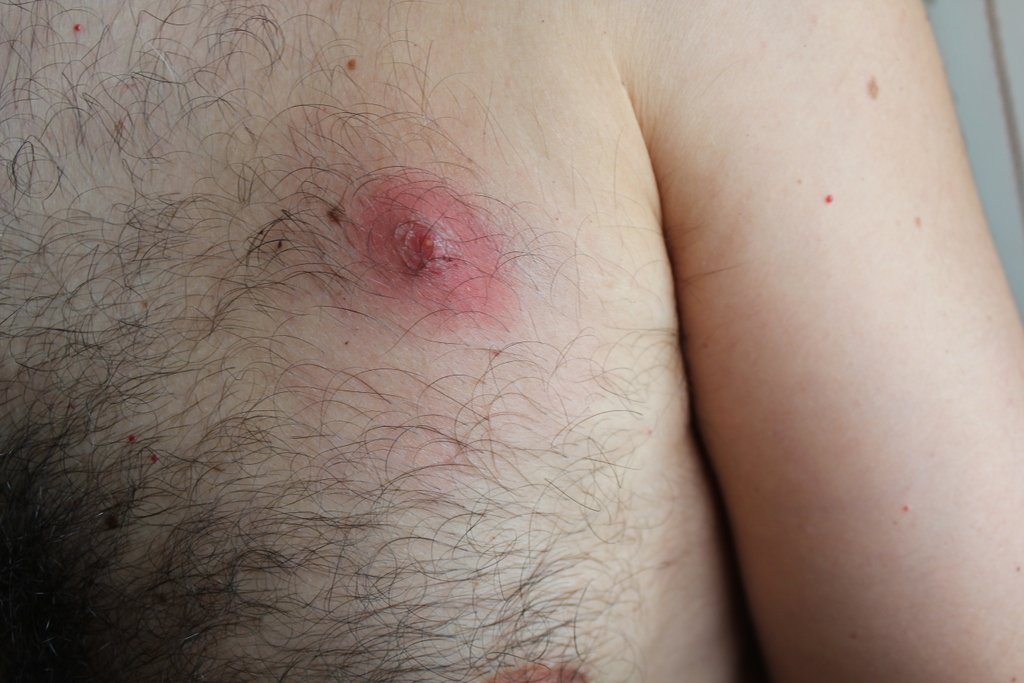
Source: DermNet
💬 Patient Explanation
|
A boil is a painful, pus-filled lump that forms when bacteria infect a hair follicle; a carbuncle is a larger cluster of boils joined together. |
🧪 Investigations
| Test | Indication |
|---|---|
| Pus swab for microscopy, culture and sensitivities (MC&S) | • If the lesion is drained, recurrent, not responding, or the patient is immunocompromised or has known meticillin-resistant Staphylococcus aureus (MRSA) • Guides targeted therapy |
| Panton-Valentine Leukocidin (PVL) testing on the swab | Request specifically – ask microbiology to test a positive S. aureus swab for PVL – where boils are recurrent, painful, necrotic, or clustered in a household or team. |
| Staphylococcal carriage screen | For recurrent boils – swab the anterior nares, and consider throat, perineum, groin and axillae – to identify carriage for decolonisation. |
| Blood glucose or HbA1c | Consider to exclude undiagnosed diabetes in recurrent or severe disease. |
| FBC (and ferritin) | Consider in recurrent furunculosis to look for anaemia or iron deficiency and other contributors. |
|
🧠 Clinical pearl • Recurrent, unusually painful or necrotic boils – or clusters appearing in a household or sports team – should raise Panton-Valentine Leukocidin (PVL) S. aureus. • A routine swab will not flag it unless you ask: request PVL testing on any positive sample. • Confirmed PVL-S. aureus is managed with specialist-guided decolonisation and, for significant infection, agents such as rifampicin plus clindamycin – not flucloxacillin alone. |
💊 Management
| All patients |
|---|
|
1. Encourage spontaneous drainage of most small boils with warm compresses, simple analgesia and good hygiene – many resolve without antibiotics. |
|
2. Do not routinely prescribe antibiotics for a small (< 5 cm), uncomplicated abscess without surrounding cellulitis in a well patient. |
|
3. Incise and drain a small fluctuant boil if you have the skills, or refer for drainage (all carbuncles and large boils) – pus needs to be released. |
|
4. Cover a draining lesion with a sterile dressing; advise on hand and household hygiene to limit spread. |
|
5. Screen for and treat staphylococcal carriage in recurrent boils, and look for contributors (diabetes, anaemia, eczema). |
| If severe/urgent |
|---|
|
• Immunocompromised patient → lower threshold for antibiotics and admission. |
|
🔑 Key principle – drain the pus, spare the antibiotic • The definitive treatment for a fluctuant boil or carbuncle is incision and drainage, not an antibiotic. • A walled-off abscess is poorly penetrated by oral antibiotics. • Reserve antibiotics for systemic features, spreading cellulitis, central-face lesions or significant comorbidity. • Use antibiotics alongside drainage rather than instead of it. |
🧾 Non-pharmacological Treatment
| Intervention | Details |
|---|---|
| Warm compresses | Apply moist heat (a warm flannel) three to four times a day to ease pain, localise the infection and hasten drainage. |
| Hygiene measures | • Careful handwashing after contact • Use separate towels and flannels • Launder clothing, bedding and towels at a high temperature • Avoid sharing personal items |
| Incision and drainage | A surgical or ED procedure for all carbuncles and large fluctuant boils (a small fluctuant boil can be drained in the practice by a skilled clinician) – the key intervention where pus has collected. |
| Avoid squeezing | Do not pick or squeeze lesions – this can spread infection and worsen scarring. |
| Activity | Avoid contact sports, shared gyms and swimming until the infection has cleared, to reduce transmission. |
⚕️ Pharmacological Treatment
| Treatment Options and Escalation |
|---|
|
➤ Pain relief |
|
→ Paracetamol or ibuprofen for local pain and discomfort. |
|
➤ When to give an oral antibiotic |
|
→ Indicated if any one of: • The patient is febrile or systemically unwell • Surrounding cellulitis • A central-face lesion • Severe pain • A large lesion or carbuncle • Significant comorbidity (e.g. diabetes, immunosuppression) → A small, uncomplicated, well-drained abscess does not need one. |
|
➤ First-line oral antibiotic |
|
→ Flucloxacillin (adult 500 mg–1 g four times daily) for 5 days, extended to 7 if severe. • Note the rare risk of cholestatic jaundice or hepatitis, which can appear up to two months after stopping. • Cholestatic jaundice or hepatitis is commoner in older patients and with prolonged courses. |
|
➤ Penicillin allergy |
|
→ Clarithromycin (adult 250–500 mg twice daily) or erythromycin (preferred in pregnancy) for 5–7 days. Withhold statins during a macrolide course, and be alert to QT prolongation and drug interactions. |
|
→ If a macrolide is unsuitable: doxycycline (200 mg day 1, then 100 mg daily) – avoid in pregnancy and in children under 12; warn about photosensitivity. |
|
➤ If meticillin-resistant Staphylococcus aureus (MRSA) known or suspected |
|
→ Do not use empirical flucloxacillin; treat according to the sensitivity pattern and local microbiology advice (options may include doxycycline, trimethoprim or clindamycin). |
|
➤ Topical antiseptics (recurrent furunculosis) |
|
→ Consider an antiseptic skin wash (e.g. chlorhexidine) to reduce skin bacterial load. |
|
➤ Staphylococcal decolonisation (confirmed recurrent carriage) – after the acute infection has resolved |
|
→ Start only once lesions have stopped discharging – suppression is ineffective while a lesion is still leaking. |
|
→ Nasal: any one of: • Naseptin® (chlorhexidine/neomycin) four times daily for 10 days – contains arachis (peanut) oil, so avoid in peanut or soya allergy • Mupirocin nasal ointment three times daily for 5 days (ideally reserved for MRSA to limit resistance) |
|
→ Skin: chlorhexidine 4% body wash daily for 5 days, used as a shampoo on days 1, 3 and 5; change and hot-wash linen and towels daily during treatment. |
|
⚠️ Common pitfall • Prescribing clarithromycin or erythromycin to a patient on a statin without pausing the statin. • Macrolides inhibit statin metabolism and sharply raise the risk of myopathy and rhabdomyolysis. • Withhold the statin for the duration of the macrolide course and restart it afterwards. |
Source: UKHSA
📌 Special Notes
|
📌 Safety – central-face lesions (the "danger triangle") • A boil on the central face (nose, upper lip, medial cheek) drains towards the cavernous sinus and carries a rare but serious risk of cavernous sinus thrombosis. • Never squeeze or incise a central-face lesion in primary care; treat promptly with antibiotics and keep a low threshold for urgent referral or admission. |
• Antibiotics are not a substitute for drainage – a fluctuant abscess needs the pus released, with antibiotics added only when there are systemic or spreading features.
• PVL-S. aureus – suspect with recurrent, painful, necrotic or clustered boils; ask microbiology to test a positive swab and discuss management before treating.
• Decolonisation timing and contacts – start only once lesions have stopped discharging, and treat the whole household simultaneously where there is recurrent cross-infection.
• Look for an underlying cause in recurrent disease – diabetes, anaemia, immunosuppression or staphylococcal carriage.
➡️ Referral Pathways
| Same-day/Urgent |
|---|
|
• Systemically unwell or suspected sepsis → emergency admission |
|
• All carbuncles, and any large fluctuant boil (or one that cannot be drained in the practice) → same-day surgical unit or ED for incision and drainage |
|
• Central-face lesion with spreading or systemic signs → urgent assessment |
|
• Immunocompromised patient with significant infection → urgent assessment or admission |
| Routine/Advice |
|---|
|
• Recurrent furunculosis not settling with carriage screening and decolonisation → dermatology |
|
• Co-existing skin condition complicating management → dermatology |
|
• Suspected or confirmed PVL-SA or meticillin-resistant Staphylococcus aureus (MRSA) → swab and seek microbiology advice |
🏠 Take Home Messages
• Drain, don't just prescribe – the definitive treatment for a fluctuant boil or carbuncle is incision and drainage; most small, uncomplicated boils settle with warm compresses and hygiene alone.
• Reserve antibiotics for clear indications – fever or systemic upset, spreading cellulitis, a central-face lesion, severe pain, a carbuncle, or comorbidity; first-line is flucloxacillin, with a macrolide in penicillin allergy.
• Escalate central-face lesions – boils in the "danger triangle" risk cavernous sinus thrombosis; treat promptly and never squeeze them.
• Think Panton-Valentine Leukocidin (PVL) in recurrent or clustered disease – request PVL testing on a positive swab when boils are recurrent, painful, necrotic, or appearing in households or teams.
• Hunt for the underlying cause – in recurrent furunculosis screen for diabetes, anaemia and staphylococcal carriage, and apply decolonisation only once the acute infection has resolved.
|
🧭 AKT – high-yield facts • A furuncle (boil) is infection of a single hair follicle; a carbuncle is a cluster of interconnected infected follicles – usually Staphylococcus aureus. • Do not give antibiotics for a small (< 5 cm) uncomplicated abscess with no cellulitis in a well patient – incise and drain if needed. • Antibiotics are indicated for fever or systemic upset, cellulitis, facial lesions, large lesions or carbuncles, or comorbidity: → First-line flucloxacillin → Penicillin allergy: clarithromycin/erythromycin (erythromycin in pregnancy) → If a macrolide is unsuitable: doxycycline • Withhold statins during a clarithromycin or erythromycin course (rhabdomyolysis risk). • Central-face boils (the "danger triangle") risk cavernous sinus thrombosis. • Recurrent, necrotic or clustered boils → consider PVL-S. aureus (request PVL on the swab). Decolonisation (Naseptin or nasal mupirocin, plus a chlorhexidine wash) is started only after the acute infection resolves; Naseptin contains arachis (peanut) oil. |
|
🎯 SCA A 24-year-old amateur rugby player attends with his third crop of painful boils in four months; two of his teammates have had similar lesions. He is well in himself but frustrated and embarrassed, worried it reflects poor hygiene, and keen for "stronger antibiotics" so he can keep playing. The challenge is to recognise a likely PVL-S. aureus pattern with a transmission risk to close contacts, to manage expectations about antibiotics, and to introduce swabbing, decolonisation and contact measures without making him feel blamed. A strong consultation: • Explores his ideas, concerns and expectations – including the impact on sport, work and self-image. • Explains in plain terms that recurrent boils usually reflect bacteria he carries, not poor hygiene. • Explains that the answer is swabs, drainage where needed and decolonisation rather than simply escalating antibiotics. • Agrees a shared plan including a PVL swab, screening for contributors and offering household or contact treatment. • Advises on not sharing towels or kit and pausing contact sport until lesions heal. • Provides clear safety-netting about returning if he becomes feverish or unwell, or develops spreading redness. • Maintains empathy and respects his autonomy throughout. |
📎Reference: NICE CKS. Boils, carbuncles and staphylococcal carriage. Available from: https://cks.nice.org.uk/topics/boils-carbuncles-staphylococcal-carriage/
📎Reference: Primary Care Dermatology Society (PCDS). Folliculitis and boils (furuncles/carbuncles). Available from: https://www.pcds.org.uk/clinical-guidance/folliculitis-an-overview
📎Reference: DermNet. Boils (furunculosis). Available from: https://dermnetnz.org/topics/boil
📎Reference: UK Health Security Agency. PVL-Staphylococcus aureus infections: diagnosis and management. Available from: https://www.gov.uk/government/publications/pvl-staphylococcus-aureus-infections-diagnosis-and-management
📎Reference: Shallcross LJ, Hayward AC, Johnson AM, Petersen I. Incidence and recurrence of boils and abscesses within the first year: a cohort study in UK primary care. Br J Gen Pract 2015;65(639):e668–76. Available from: https://pmc.ncbi.nlm.nih.gov/articles/PMC4582880/
Three whole topics are free to read. Every topic opens with a free account.
Your CPD is counted as you read, and kept from the day you join.
Join us, it’s free