 GPAtlas
🧭 When to suspect
Anaphylaxis is a severe, life-threatening, generalised hypersensitivity reaction. It is a clinical diagnosis resting on three features:
• sudden onset
• rapid progression
• a life-threatening Airway, Breathing or Circulation (ABC) problem.
Skin and mucosal changes (urticaria, flushing, angio-oedema) accompany most cases but are absent in up to 20% – so their absence never excludes the diagnosis.
Exposure to a known allergen supports it, yet no trigger is found in around 30% (idiopathic).
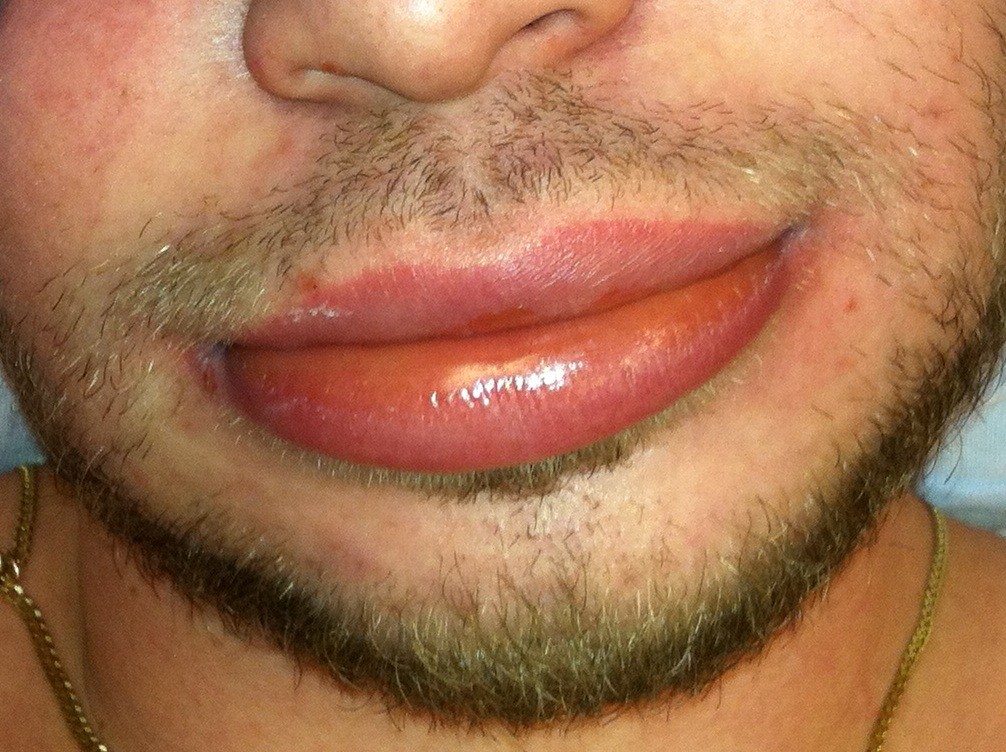
Angio-oedema is self-limiting deep dermal and subcutaneous swelling (lips, tongue, eyelids, genitalia, hands, feet).
• The swelling is typically non-itchy and tight rather than the itchy weals of urticaria, and may take up to 72 hours to settle.
• The decisive question is mechanism: histaminergic (mast-cell/allergic, responds to antihistamines and adrenaline) versus bradykinin-mediated (ACE inhibitor or hereditary).
• Bradykinin-mediated swelling does not respond to antihistamines, steroids or adrenaline.
• The two primary-care priorities are to never miss evolving anaphylaxis – any ABC involvement means IM adrenaline now – and to identify and remove the trigger.
| Pattern | Recognise it by | First action |
|---|---|---|
| Anaphylaxis | • Sudden onset, rapid progression, life-threatening Airway, Breathing or Circulation problem • Skin changes usual but absent in up to 20% |
IM adrenaline now + call 999 |
| Histaminergic angio-oedema (± urticaria) | • Itchy swelling, often with weals • Mast-cell/allergic • Lips, eyelids, tongue |
• Non-sedating antihistamine • Treat as anaphylaxis if any ABC involvement |
| Bradykinin-mediated angio-oedema (ACE inhibitor or hereditary) | • Non-itchy, no weals • Slower onset • Face, tongue, larynx • Poor response to antihistamine, steroid and adrenaline |
• Stop the ACE inhibitor • Protect the airway • Specialist treatment with C1-esterase inhibitor (C1-INH) or icatibant if the airway is threatened |
Source: Resuscitation Council UK · NICE NG258
🩺 History
| Ask about symptoms |
|---|
|
• Airway symptoms – throat tightness or closing, hoarse voice, stridor, difficulty swallowing? |
|
• Breathing symptoms – shortness of breath, wheeze, persistent cough? |
|
• Circulation symptoms – dizziness, faintness, collapse, or a sense of "impending doom"? |
|
• Skin or mucosal changes – urticaria (weals), flushing, or angio-oedema? |
|
• Gastrointestinal symptoms – abdominal pain, vomiting, incontinence (can accompany venom or food anaphylaxis)? |
|
• Is the swelling itchy (suggests histaminergic) or non-itchy and tight (suggests bradykinin), and how fast did it come on? |
| Ask about risk factors and modifiers |
|---|
|
• Trigger – food, drug, insect sting, latex, exercise, or none identified (idiopathic)? |
|
• Drug history – ACE inhibitor (current or recent, even after years of use) or beta-blocker? |
|
• Atopy, asthma, COPD or cardiovascular disease (these raise the risk and severity of a reaction)? |
|
• Co-factors that amplify reactions – exercise, alcohol, NSAIDs, intercurrent infection? |
|
• Previous episodes – did they resolve spontaneously or need treatment; any previous anaphylaxis? |
|
• Family history of recurrent swelling (hereditary angio-oedema)? |
| 🧩 Patient Perspective |
|---|
|
➤ "Explore the patient's understanding of the trigger and their anxiety about another reaction?" |
|
➤ "Ask whether they already have an adrenaline auto-injector, whether they carry it, and how confident they feel using it?" |
Source: Resuscitation Council UK · NICE NG258
⚠️ Red Flags
| Escalation criteria |
|---|
|
➤ Airway: • Throat or tongue swelling • Difficulty swallowing • Hoarse voice • Stridor → IM adrenaline + 999 |
|
➤ Breathing: • Severe breathlessness • Wheeze • Cyanosis • SpO₂ < 92% • Confusion from hypoxia → IM adrenaline + 999 |
|
➤ Circulation → any one of: • Pale and clammy • Tachycardia • Hypotension • Faintness • Collapse → IM adrenaline + 999 |
|
➤ Disability → any one of: • Reduced consciousness • Agitation • Sudden behavioural change |
|
➤ Worsening or no improvement in breathing or circulation despite two appropriate IM doses → refractory anaphylaxis → specialist IV adrenaline |
|
➤ ACE inhibitor or hereditary angio-oedema with progressing tongue or throat swelling → bradykinin-mediated airway threat → secure the airway early |
Source: Resuscitation Council UK · NICE NG258
🔎 Examination
| Examination findings and signs (ABCDE) |
|---|
|
➤ Airway/Breathing: • Listen for stridor (upper airway) or wheeze (lower airway) • Count the respiratory rate • Check SpO₂ |
|
• Circulation – pulse, blood pressure and capillary refill time; look for pallor and sweating (shock). |
|
• Skin/mucosa – urticaria, flushing and angio-oedema (lips, eyelids, tongue, soft palate). |
|
• Disability – conscious level (AVPU), agitation or confusion. |
|
• Exposure – look for a sting site, an infusion or IV site or another trigger, and assess the extent of any swelling. |
|
🧠 Clinical pearl • A swollen lip, tongue or face with no itch and no weals points away from a simple allergy and towards bradykinin-mediated angio-oedema. • The commonest cause is an ACE inhibitor. • The swelling can appear after years of uneventful use, so a long-standing prescription does not exclude it. • Adrenaline, antihistamines and steroids work poorly here. • The priorities are airway vigilance and stopping the drug. |
Source: Resuscitation Council UK
💬 Patient Explanation
|
Anaphylaxis is a severe, whole-body allergic reaction that affects your breathing or blood pressure and needs an adrenaline injection straight away. |
🧪 Investigations
| Test | Indication |
|---|---|
| Serum mast cell tryptase |
Supports a retrospective diagnosis; usually taken in hospital. Timing is critical – ideally three samples: • As soon as possible after resuscitation begins • A second at 1–2 hours (no later than 4 hours) after onset • A convalescent baseline at ≥ 24 hours or at the allergy clinic |
| Specific immunoglobulin E (IgE) or skin-prick testing | • Identifies the culprit allergen • Arranged by the specialist allergy clinic at follow-up, not acutely |
| C4 and C1-esterase inhibitor – specialist-initiated | If hereditary or acquired angio-oedema is suspected – recurrent non-itchy swelling without urticaria, often with abdominal pain or a family history. |
| Repeated baseline tryptase | If consistently elevated between episodes, consider mastocytosis – specialist referral. |
Source: Resuscitation Council UK · NICE NG258
💊 Management
| Step-by-step approach |
|---|
|
1. Use an Airway, Breathing, Circulation, Disability, Exposure (ABCDE) approach; anaphylaxis is a clinical diagnosis – do not wait for a complete history before treating. |
|
2. Give IM adrenaline into the anterolateral thigh immediately for suspected anaphylaxis (any ABC problem). |
|
3. Position the patient flat with legs raised and never let them stand suddenly. |
|
4. Remove the trigger where possible. |
|
5. Treat stable, isolated angio-oedema (no ABC problem): • Identify and avoid the cause • Stop any ACE inhibitor • Give a non-sedating antihistamine if the swelling is histaminergic (itchy, often with weals) |
|
6. Prescribe two adrenaline auto-injectors after emergency treatment, train the patient and refer to a specialist allergy service. |
| If severe/urgent |
|---|
|
• Refractory anaphylaxis = no improvement in breathing or circulation after two appropriate IM doses → IV adrenaline infusion by experienced specialists. |
|
• High-flow oxygen (target 94–98%). • A crystalloid fluid bolus if shocked. • An inhaled bronchodilator for persistent wheeze. |
|
• Rapidly progressing tongue or throat swelling → secure the airway early. Bradykinin-mediated swelling responds poorly to adrenaline, antihistamines and steroids. |
|
• Corticosteroids are no longer part of routine emergency treatment – reserve for refractory cases and never prioritise them over adrenaline and fluids. |
|
• Observe after recovery (risk of a biphasic reaction) and admit any rapidly developing or airway-threatening angio-oedema. |
|
🔑 Key principle – adrenaline first, fast, and repeated • Intramuscular adrenaline is the only first-line treatment for anaphylaxis. • Oxygen, fluids and bronchodilators are adjuncts. • Antihistamines and steroids treat neither the airway nor the circulation. • Give adrenaline early into the thigh and repeat at 5 minutes. • If two doses fail, escalate to specialist IV adrenaline. • The fatal risk is delay in giving adrenaline, not the drug itself. |
Source: Resuscitation Council UK · NICE NG258
🧾 Non-pharmacological Treatment
| Intervention | Details |
|---|---|
| Positioning | • Lie flat with legs raised to support the circulation • Left lateral if pregnant • Semi-recumbent only if breathing is easier • Standing, walking or sitting up suddenly can cause fatal collapse – patients must not stand |
| Trigger removal | • Scrape (don't squeeze) out a bee sting • Stop any implicated IV infusion immediately • Do not induce vomiting after a food trigger |
| Monitoring | Continuous Airway, Breathing, Circulation, Disability, Exposure (ABCDE) assessment, with pulse oximetry, blood pressure and ECG where available. |
| Avoidance & co-factors | Once the trigger is known, give clear written avoidance advice and warn about co-factors (exercise, alcohol, NSAIDs, infection) that lower the reaction threshold. |
| Self-management plan | • A personalised British Society for Allergy and Clinical Immunology (BSACI) allergy action plan • Auto-injector training with a trainer pen • A medical-alert bracelet Together, these reduce the risk of a future fatal reaction. |
Source: Resuscitation Council UK · MHRA
⚕️ Pharmacological Treatment
| Treatment Options and Escalation |
|---|
|
➤ Anaphylaxis – first-line, life-saving |
|
→ IM adrenaline 1:1000 (1 mg/mL) into the anterolateral thigh, repeated every 5 minutes if no improvement. |
|
→ Adult and child over 12 years: 500 micrograms (0.5 mL). |
|
→ Child 6–12 years: 300 micrograms (0.3 mL). |
|
→ Child 6 months to 6 years: 150 micrograms (0.15 mL). |
|
→ Child under 6 months: 100–150 micrograms (0.1–0.15 mL). |
|
➤ Anaphylaxis – adjuncts (never delay adrenaline) |
|
→ Oxygen: high-flow via reservoir mask, target 94–98% (88–92% if at risk of CO₂ retention). |
|
→ IV fluids: crystalloid bolus (e.g. 500–1000 mL in an adult; 10 mL/kg in a child) if shocked; large volumes may be needed. |
|
→ Bronchodilator: inhaled or nebulised salbutamol (± ipratropium) for persistent wheeze; nebulised adrenaline (5 mL of 1 mg/mL) for upper-airway obstruction. |
|
➤ Refractory anaphylaxis – specialist only |
|
→ After two appropriate IM doses without improvement: IV adrenaline infusion by an experienced specialist. IV adrenaline given to a patient with a spontaneous circulation risks dangerous hypertension and arrhythmia. |
|
→ A corticosteroid may be considered here, after resuscitation, but must not be prioritised over adrenaline and fluids. |
|
➤ Stable angio-oedema (histaminergic) – routine |
|
→ Non-sedating antihistamine, e.g. cetirizine 10 mg once daily or fexofenadine 180 mg once daily, for up to 6 weeks. → If persistent or recurrent, continue daily for 3–6 months, then review. |
|
→ If severe, add a short course of prednisolone (e.g. 40 mg once daily for up to 7 days). |
|
➤ Bradykinin-mediated angio-oedema (ACE inhibitor or hereditary) – specialist for airway threat |
|
→ Stop the ACE inhibitor permanently. The swelling responds poorly to antihistamines, steroids and adrenaline. → Hereditary and acquired forms are treated with C1-esterase inhibitor or icatibant under specialist care. |
|
➤ Discharge/prophylaxis |
|
→ Two adrenaline auto-injectors as an interim measure for those at risk, with training, plus referral to a specialist allergy service. → Review beta-blocker use, which can reduce the response to adrenaline. |
|
⚠️ Common pitfall • Reaching for chlorphenamine and hydrocortisone first. • Antihistamines and steroids do nothing for the airway or circulation, and corticosteroids are no longer recommended in routine emergency anaphylaxis. • Corticosteroid use too often delays the one treatment that works. • For any Airway, Breathing or Circulation problem, give IM adrenaline first and treat everything else as an adjunct. |
Source: Resuscitation Council UK · BSACI
📌 Special Notes
|
📌 Safety – biphasic reactions and the period of observation • Symptoms can recur hours after they first settle (a biphasic reaction), so a patient who looks better is not necessarily safe. Following NICE, observe from the resolution of symptoms for: • a minimum of 2 hours (good response within 5 to 10 minutes to a single IM adrenaline dose given within 30 minutes of the onset of anaphylaxis, fully resolved, owns and can use two in-date auto-injectors, and is adequately supervised) • a minimum of 6 hours (two doses needed, or a previous biphasic reaction) • a minimum of 12 hours (severe asthma or severe respiratory compromise, possible continuing allergen absorption, a late-evening or night presentation, or difficulty accessing emergency care). |
• ACE inhibitors – stop immediately and do not restart in anyone with angio-oedema. Switch to another class (e.g. a calcium-channel blocker). An angiotensin receptor blocker (ARB) carries only a small residual risk of the same reaction, so if one is used, prescribe it with caution and clear safety-netting.
• Beta-blockers – can reduce the response to adrenaline. Review whether they are still needed in a patient who requires auto-injectors. Glucagon may be used in refractory cases under specialist care.
• Idiopathic anaphylaxis – no trigger is found in roughly a third of cases; the diagnosis rests on the history once other causes are excluded.
• Co-factors – exercise, alcohol, NSAIDs and intercurrent infection can lower the threshold and turn a previously tolerated exposure into a reaction.
• Referral is for everyone – every person treated for anaphylaxis should be referred to a specialist allergy service, regardless of how quickly they recovered.
Source: Resuscitation Council UK · NICE NG258 · MHRA
➡️ Referral Pathways
| Same-day/Urgent |
|---|
|
• Anaphylaxis or rapidly developing angio-oedema → 999 or emergency admission, regardless of apparent improvement. |
|
• Airway-threatening angio-oedema (especially ACE inhibitor or hereditary) → emergency admission; secure the airway early. |
|
• Stable angio-oedema worsening or not improving on treatment → consider hospital admission. |
| Routine |
|---|
|
• Specialist allergy or immunology service → everyone after anaphylaxis, for diagnosis, trigger identification, education and an action plan. |
|
• Suspected hereditary or acquired angio-oedema, swelling persisting or recurring 3 months after stopping an ACE inhibitor, or an unidentifiable/unavoidable cause → immunology/dermatology. |
|
• At-risk patients awaiting specialist review → ensure two auto-injectors and training are in place in the meantime. |
Source: NICE NG258 · Resuscitation Council UK · BSACI
🏠 Take Home Messages
• Anaphylaxis is a clinical diagnosis – sudden onset, rapid progression and a life-threatening Airway, Breathing or Circulation problem; skin changes are absent in up to 1 in 5, so their absence never rules it out.
• Give IM adrenaline into the thigh immediately for any ABC problem and repeat at 5 minutes; two doses without improvement is refractory anaphylaxis needing specialist IV adrenaline.
• Antihistamines and steroids are not the treatment – corticosteroids are no longer routine in emergency anaphylaxis; position the patient flat with legs raised and never let them stand.
• Stop the ACE inhibitor in anyone with angio-oedema; suspect bradykinin-mediated swelling when it is non-itchy, has no weals and does not respond to adrenaline, antihistamines or steroids – and remember it can start after years of use.
• Safety-net and follow up – two auto-injectors with training, a written action plan, observation for biphasic reactions, and referral of every patient to a specialist allergy service.
Source: Resuscitation Council UK · NICE NG258
|
🧭 AKT – high-yield facts • Adrenaline (IM, 1:1000): → Over 12 years or adult 500 micrograms → 6–12 years 300 micrograms → 6 months–6 years 150 micrograms → Under 6 months 100–150 micrograms → Repeat at 5 minutes • Refractory anaphylaxis = no improvement in breathing/circulation after two appropriate IM doses → specialist IV adrenaline infusion. • Corticosteroids are no longer recommended for routine emergency anaphylaxis; antihistamines are not first-line and treat only skin symptoms once stabilised. • Mast cell tryptase: three timed samples – at presentation (after resuscitation starts), 1–2 hours after onset, and a convalescent baseline at ≥ 24 hours. • Skin or mucosal changes are absent in up to 20% of anaphylaxis; no trigger is found in about 30% (idiopathic). • ACE inhibitor angio-oedema is bradykinin-mediated, non-itchy, can occur years into treatment, and responds poorly to adrenaline, antihistamines and steroids. • Observation after recovery: minimum 2, 6 or 12 hours depending on doses needed, asthma severity, ongoing absorption and timing of presentation. |
|
🎯 SCA A 64-year-old man, on ramipril for several years for hypertension, presents with a second episode in two months of swelling of the lips and tongue. There is no itch and no rash, and his airway is currently comfortable. He is reluctant to stop a tablet that "has never caused problems", and his blood pressure is well controlled on it. The dilemma is that this is almost certainly ACE inhibitor–induced (bradykinin-mediated) angio-oedema despite years of uneventful use, which seems counterintuitive to the patient. The next episode could threaten his airway, yet stopping the drug means changing effective long-term treatment. A strong consultation: • Explores his ideas, concerns and expectations (including why an "old, trusted" tablet could suddenly be blamed). • Explains in plain terms that the swelling is a known, unpredictable effect of this drug class and is not a simple allergy that antihistamines fix. • Stops the ACE inhibitor permanently and agrees an alternative antihypertensive (e.g. a calcium-channel blocker). • Counsels that an angiotensin receptor blocker (ARB) carries only a small residual risk. • Safety-nets explicitly to call 999 for any tongue, throat or breathing involvement. • Arranges review with immunology referral if episodes continue after stopping. • Respects his autonomy throughout. |
📎Reference: NICE. Anaphylaxis: assessment and referral after emergency treatment. NICE guideline NG258. Available from: https://www.nice.org.uk/guidance/ng258
📎Reference: Resuscitation Council UK. Emergency treatment of anaphylactic reactions: Guidelines for healthcare providers (2021). Available from: https://www.resus.org.uk/library/additional-guidance/guidance-anaphylaxis/emergency-treatment
📎Reference: NICE CKS. Angio-oedema and anaphylaxis. Available from: https://cks.nice.org.uk/topics/angio-oedema-anaphylaxis/
📎Reference: MHRA. Adrenaline auto-injectors (AAIs): new guidance and resources for safe use. Drug Safety Update, June 2023. Available from: https://www.gov.uk/drug-safety-update/adrenaline-auto-injectors-aais-new-guidance-and-resources-for-safe-use
📎Reference: Angier E, Choudhury D, et al; BSACI. Adrenaline auto-injector prescription for patients at risk of anaphylaxis: BSACI guidance for primary care. Available from: https://www.bsaci.org/guidelines-and-standards/primary-care-guidelines/adrenaline-auto-injector-prescription-for-patients-at-risk-of-anaphylaxis-bsaci-guidance-for-primary-care/
Three whole topics are free to read. Every topic opens with a free account.
Your CPD is counted as you read, and kept from the day you join.
Join us, it’s free